Select a site alphabetically from the choices shown in the box below. Alternatively, browse sculptural examples using the Forward/Back buttons.
Chapters for this volume, along with copies of original in-text images, are available here.


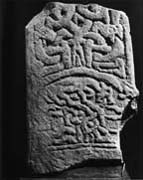
Object type: Base of shaft [1]
Measurements: H. 67 cm (26.5 in); W. 43 cm (17 in); D. 15.2 cm (6 in)
Stone type: Coarse-grained, massive yellow sandstone
Plate numbers in printed volume: Pl. 192.1063-1066
Corpus volume reference: Vol 1 p. 197
(There may be more views or larger images available for this item. Click on the thumbnail image to view.)
A (broad): (i) Edged by a vertical flat-band moulding and divided from the one below by an irregular curved flat-band. A random lumpy interlace fills the frame and on either side emerge two birds' heads with round eyes. Their open beaks peck the strands. In the centre is what looks like the lower part of a human body. (ii) The base is edged by a wavering roll moulding. At the top is a recumbent quadruped. The curve of its back is formed by punching the outline of the curved frame, and its tongue and two of its legs dissolve into a jumble of interlace below. It has a lumpy forehead, prominent pointed ear, canine jaws and a deeply punched eye.
B (narrow): Plain.
C (broad): The face is edged by a punch-outlined flat-band moulding and the two panels are divided by a curved thick roll moulding which possibly terminated in a bird's head. (i) Interlace: a bungled paired pattern C within a pattern E loop. (ii) A punch-outlined curvilinear design.
D (narrow): One panel survives. The vertical grooved mouldings and the design are formed by a punch-outlined technique. The strands of the pairs of unpinned loops are humped and discontinuous.
The poorly executed design on face D is found on Anglo-Scandinavian crosses. The tangled animal-headed interlace with parts of human figures can also be compared with such work, for example, at Gainford (no. 5). The quadruped with lolling tongue and the odd coiled incised ornament finds its closest parallel at Chester-le-Street (no. 1). Adcock (1974, 284-6) compares the interlace with a fragment from Coldingham and considers that the sculptor did not understand his subject and that he probably derived the idea from earlier Lindisfarne work. She considers that the cross-arm, no. 16, is part of the same monument. Altogether this is a deterioration from the earlier group and with its reflection of Viking taste could well be as late as the tenth century.
