Select a site alphabetically from the choices shown in the box below. Alternatively, browse sculptural examples using the Forward/Back buttons.
Chapters for this volume, along with copies of original in-text images, are available here.


Object type: Probably part of cross-shaft [1]
Measurements: Unobtainable
Stone type: Unobtainable
Plate numbers in printed volume: Fig. 19; Pl. 194.1088
Corpus volume reference: Vol 1 p. 198-199
(There may be more views or larger images available for this item. Click on the thumbnail image to view.)
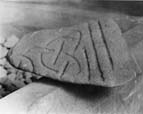
A (broad): This fragment can only be discussed in relation to Peers's drawing and a poor photograph taken by the author in 1959. The stone has been lost since that date. The face seems to have been edged by outer flat-band and inner roll mouldings and the pattern of mirror-image interlace is incised with gaps between the crossing points of the strands: a long pattern A loop is threaded through by an added diagonal, forming an included U-bend terminal.
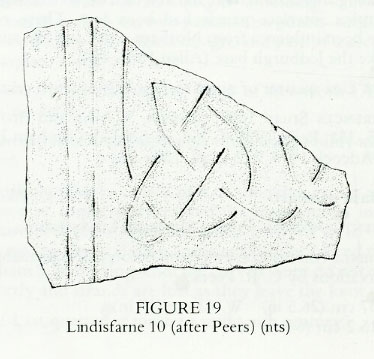
Adcock (1974, 177, fig. 31c) has established the face as about 37 cm wide with 6 cm for the mouldings and considers it could have been a ten-cord pattern which would compare with a fragment from Jedburgh, Roxburghshire (ibid., fig. 31A-Bi). Such incised interlace patterns occur elsewhere: in Pictland at Nigg and Aberlemno (ibid., pl. 51A-s); in Cumbria at Irton (ibid., pl. 111B-C); at Wharram Percy, Yorkshire, on one face of a cross-arm (Andrews 1979, 124, fig. 66); and at Lastingham, Yorkshire, the interlace is incised on the narrow face of the arm of a piece of furniture (Adcock 1974, pl. 35).
It is possible in some designs that the gaps between the strand crossings could have been left in order to work into relief form. However, on a cross from Ilkley, in which three faces are carved in relief and one is incised, it seems more likely that there is a deliberate variation of effect (Collingwood 1915, 195L). It is possible therefore that such incised interlace was conceived as a deliberate alternative to relief, just as dotted interlace in the Lindisfarne Gospels contrasts with that which is fully painted. The pattern resembles that on Alnmouth (face C).
