Select a site alphabetically from the choices shown in the box below. Alternatively, browse sculptural examples using the Forward/Back buttons.
Chapters for this volume, along with copies of original in-text images, are available here.


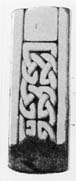
Object type: Part of cross-shaft [1]
Measurements: (after Stuart 1867) H. 35.5 cm (14 in); W. 22.8 cm (9 in); D. 15.2 cm (6 in)
Stone type: Unknown
Plate numbers in printed volume: Pl. 192.1067-1070
Corpus volume reference: Vol 1 p. 199
(There may be more views or larger images available for this item. Click on the thumbnail image to view.)
This can only be described from Gibb's drawing in Stuart (1867, pl. xxvi, 1), which may not be entirely accurate. It is not clear whether it is one stone in two pieces with two faces surviving, or four faces of one fragment, as described below. The shaft is edged by a single roll moulding.
A (broad): The face is not subdivided into panels but each unit is shown as distinct. (i) Part of a plain plait. (ii) A double row of pellets. (iii) A single twist. (iv) A key pattern (Allen 1903, no. 996). (v) The terminals of an interlace pattern.
B (narrow): (i) A double plain panel. (ii) A straight line pattern. (iii) Possibly alternating half pattern D with bar terminal.
C (broad): (i) Terminals of an interlace. (ii) A twist. (iii) A bungled spiralled plait.
D (narrow): (i) Plain. (ii) Three units of turned pattern C with bar terminal.
Adcock (1974, 276-7) discusses the rarity of the pattern c type on face B, but sees this shaft as fitting well into the Bernician context. Certainly it has much the same formula as 5 and 6 and should be of the same date. The key pattern is paralleled on Alnmouth.
