Select a site alphabetically from the choices shown in the box below. Alternatively, browse sculptural examples using the Forward/Back buttons.
Chapters for this volume, along with copies of original in-text images, are available here.


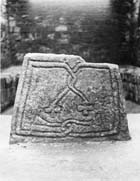
Object type: Cross-base, in two joining pieces, now reunited [1]
Measurements:
H. 55.9 cm (22 in); W. 82.5 > 64.8 cm (32.5 > 25.5 in); D. 50.8 > 43.2 cm (20 > 17 in)
Socket: 29.9 x 17.2 x 19 cm (11.75 x 6.75 x 7.5 in)
Stone type: Medium-grained pink/yellow sandstone
Plate numbers in printed volume: Pls. 196.1103-1105, 197.1106-1107
Corpus volume reference: Vol 1 p. 201
(There may be more views or larger images available for this item. Click on the thumbnail image to view.)
Base of trapezoid shape, with a socket. The socket does not seem to fit any cross which survives. All faces are ornamented by grooved mouldings.
A (broad): The moulding is conceived in terms of two `cords', which at the base interlock and lie horizontally, and at the top twist and hang vertically. The terminals of the lower `cords' are wedge-shaped, those of the upper cruciform.
B (narrow) and C (broad): Plain within a double flat-band moulding.
D (narrow): The inner moulding rises in a shallow irregular are at the base; otherwise plain.
There is no close parallel for this base, although a fairly plain base of a comparable type exists at Hornby, Lancashire. The simple ornament gives the impression that the base is covered with a cloth, with decorative bindings and ties. Another such skeuomorphic treatment in Northumbria is the grave-cover with `tassels' carved on a stone at Kirkdale, Yorkshire (Collingwood 1927, fig. 21).
