Select a site alphabetically from the choices shown in the box below. Alternatively, browse sculptural examples using the Forward/Back buttons.
Chapters for this volume, along with copies of original in-text images, are available here.


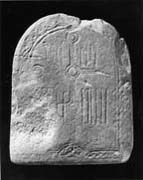
Object type: Round-headed grave-marker [1]
Measurements: H. 23.5 cm (9.25 in); W. 19 cm (7.5 in); D. 3.8 cm (1.5 in)
Stone type: Fine-grained reddish sandstone
Plate numbers in printed volume: Pl. 199.1113
Corpus volume reference: Vol 1 p. 204
(There may be more views or larger images available for this item. Click on the thumbnail image to view.)
Only one face is carved.
A (broad): The double-incised inner frame is surrounded by a broader outer frame of interlace which also fills the foot of the cross. The cross which is small in relation to the space available is the median-incised type G1 with an extended stem terminating in a semicircular foot of type F1. The border has traces of a four-strand twist (G.I., fig. 26Bi) and a three-strand plain plait (bottom right). All four quadrants are inscribed, the upper two in runes, the lower two in elongated Anglo-Saxon capitals:
(a) Upper quadrants:
[. a] m II wini
(b) Lower quadrants:
[— A.] II UINI
This probably belongs to the type of monument on which the name of the deceased is repeated in runes and Latin characters, although Page (1973, 143) implies that this could be two persons with the same second element to the name. The shrunken incised cross combined with the outer frame in relief, and the two rather badly lettered inscriptions could put this late in the series. However, it could be the work of an incompetent craftsman.
