Select a site alphabetically from the choices shown in the box below. Alternatively, browse sculptural examples using the Forward/Back buttons.
Chapters for this volume, along with copies of original in-text images, are available here.


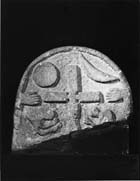
Object type: Round-headed grave-marker [1]
Measurements: H. (centre) 28 cm (11 in), possibly originally 33 cm (13 in); W. (base) 42 cm (16.5 in); D. 8.5 cm (3.25 in)
Stone type: Greyish sandstone
Plate numbers in printed volume: Pl. 201.1132-1134
Corpus volume reference: Vol 1 p. 206-207
(There may be more views or larger images available for this item. Click on the thumbnail image to view.)
A flat-band moulding follows the semi-circular head of the slab on both broad faces.
A (broad): In the centre is a standing cross, type A12. Two hands point towards each of its horizontal arms. In the upper spandrels are the sun on the left and the moon on the right. In the lower spandrels are two side-facing figures, bowing with hands outstretched to the cross. They have round heads, rather prominent noses and no details of clothing are visible.
B, D and E (narrow sides and top): Plain.
C (broad): This face is entirely filled by a procession of armed men advancing from left to right. They all seem to be dressed below the waist in a peculiar ridged garment which does not reach their knees. They each have the distinctive beaky profile of the men on the other face, with a lentoid eye set centrally in the face. The man on the extreme left raises his right arm in the air. In front of him three men brandish swords, and two axes. The man in front has no space in which to raise his arms and so is rather crushed against the frame.
This dramatic carving is finished in a smoothed and polished technique which is quite unlike anything else at Lindisfarne, except the early name-stones. The style of the figures is not unlike the cross-base, Chester-le-Street 11, or the Great Stainton shaft. The iconography is however unique. On face A the appearance of the sun and the moon on either side of an empty cross to which hands point, and to which figures bow, seems most likely to be a reference to the Day of Judgement, which in Old English literature is referred to in Cynewulf's Domesday[2]. This would then be seen as complementary to the scene on the other side, which seems to depict a raid of armed men. This could represent a Scandinavian raid such as took place in 793 at Lindisfarne, or in the tenth century, or indeed a Scottish raid. Alcuin saw the Scandinavian raids as a judgement, but this same theme is also pursued by later English writers such as Aelfric. The artist seems to have taken some trouble to depict a different sort of dress from the short secular tunic, but whether this is Scandinavian or Scottish one cannot say. The details of the sword pommels which appear to be rounded indicate a date not much after 900. It is possible this stone commemorated the dead lost in a raid on Lindisfarne, but which raid it is impossible to say.
1. The following are general references to the Lindisfarne stones: (—) 1855-7e, 275; (—) 1869-79c, viii; Rivoira 1933, 153; Elliott 1959; 81; Henry 1965, 158; Coatsworth 1981, 25.
2. Since the writing of this entry a very full account of the theme of Domesday on this stone, on others and in Old English literature has been published by Bailey (1980, 162-70).
