Select a site alphabetically from the choices shown in the box below. Alternatively, browse sculptural examples using the Forward/Back buttons.
Chapters for this volume, along with copies of original in-text images, are available here.


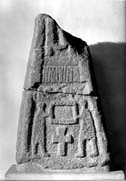
Object type: Lower part of grave-marker, in two joining pieces
Measurements: H. 31 cm (12.3 in); W. 19 > 12.2 cm (7.4 > 4.8 in); D. 6.5 cm (2.6 in)
Stone type: Medium-grained, micaceous sandstone [1]
Plate numbers in printed volume: Pl. 107.592-595
Corpus volume reference: Vol 1 p. 123
(There may be more views or larger images available for this item. Click on the thumbnail image to view.)
Edged by a wide flat-band moulding.
A (broad): The surface is roughly finished with a pecked surface, save for the area around and above a runic inscription. The face is divided by the inscription, which is surrounded by an incised outline. It reads:
tidfirþ
This is a masculine personal name. Above is an enigmatic design in relief: a roughly shaped loop between two uprights. Below, two figures face one another in profile and grasp a small rectangular panel with a sunken centre in their hands. They have small heads and knee-length straight garments. The one on the right is slightly wider and seems to wear a skirt. The one on the left could be wearing breeches or a skirt. Below the panel is a standing cross, type B10.
B (narrow): As D, except that the grooves do not return across the bottom.
C (broad): The face is outlined by two broad flat bands, which curve slightly. A figure, facing right, is shown in movement. It has grotesquely elongated arms, and it is impossible to see how it is dressed. The background is pecked as on A. A rectangular area attached to the frame has been left uncarved at the higher level of the frame above the head of the figure.
D (narrow): The face is smoothly dressed and is divided up by two punch-incised grooves returned across the bottom, giving a broad central panel.
This shape of stone is also found at Bothal (no. 3), where the figure type is similar, as is also the technique of grooving and picking the outline. However, the surface of this stone is rougher than Bothal. This is the simplest form of memorial stone, in which solely the name of the deceased appears – a type of memorial which spans the period from the seventh to the eleventh century (Page 1973, 142-3). However, the method of carving, the figure type and the cross shape, all betray a late date. It is possible that the origin of this scene was a narrative type such as on 7, but no obvious iconography suggests itself. The purely runic inscription is interesting. Mixtures of runic characters and capitals appear at Chester-le-Street (no. 1) and Alnmouth, but this seems to be the latest solely runic inscription in the area.
