Select a site alphabetically from the choices shown in the box below. Alternatively, browse sculptural examples using the Forward/Back buttons.
Chapters for this volume, along with copies of original in-text images, are available here.


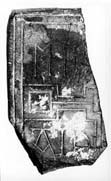
Object type: Incomplete grave-marker
Measurements: H. 10 cm (4 in); W. 5.7 cm (2.25 in); D. 1.5 cm (0.6 in)
Stone type: Fine-grained, calcareous red sandstone or siltstone
Plate numbers in printed volume: Pl. 110.600
Corpus volume reference: Vol 1 p. 123-124
(There may be more views or larger images available for this item. Click on the thumbnail image to view.)
(a) Upper left quadrant:
eo II —
(b) Lower left quadrant:
[ĂID] II —
The second letter of the second inscription may have been an 'L'.
B and F: Broken off.
C, D and E: Smoothly dressed.
This tiny stone is the smallest surviving name-stone, and one wonders whether it was originally set in a wall, or placed in a grave. The cross form is the square-ended type, favoured by Monkwearmouth/Jarrow carvers, but the stud-like centres remind one of the `metalwork' type of cross found in Hiberno-Saxon manuscripts, such as the Lindisfarne Gospels, fol. 2v (pl. 262, 1422), and the Lichfield Gospels, p. 218. The names, which are clearly two different ones, are probably those used before and after entry into the religious life. Their genders are indeterminable.
