Select a site alphabetically from the choices shown in the box below. Alternatively, browse sculptural examples using the Forward/Back buttons.
Chapters for this volume, along with copies of original in-text images, are available here.


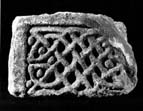
Object type: Part of impost, cross-shaft or piece of furniture
Measurements: H. 19 cm (7 in); W. 31.5 cm (12.5 in); D. 25 cm (10 in)
Stone type: Hartlepool and Roker dolomite
Plate numbers in printed volume: Pl. 111.605-608
Corpus volume reference: Vol 1 p. 124-125
(There may be more views or larger images available for this item. Click on the thumbnail image to view.)
A (broad): A panel of deeply cut interlace within a broad flat-band moulding; it is composed of pattern D with outside strands terminating in elongated pointed loops. A triangle of loose pellets fills the hole points between the strands at the end of the pattern, and there is one other pellet in the centre of the composition.
B and F: Broken away.
C and D: Plain and covered by mortar.
E (top): Part of a wide flat-band moulding survives. On the left there is a fine zig-zag pattern with a pellet in each V of the pattern, which may turn at the corner.
Although it is very difficult to be certain of the pattern on E because of the mortar, it must be the top of the feature; the interlace on B likewise terminates below the moulding. The zig-zag with pellet filling can be a Roman motif but the pellets are repeated on two faces. Fine zig-zag patterns can occur in early work (e.g. Jarrow 8-9). The motif also survives into the Merovingian period in France. One of the sarcophagus covers from Jouarre is edged by a zig-zag with pellets in each division another has a fine twist with interspersed pellets (Maillé 1971, fig. 19). Other Merovingian fragments of plaster sarcophagi from Jouarre have fine line interlace pattern: interspersed with pellets (ibid., fig. 21). The interlace type on B is unlike the others at Monkwearmouth, both in pattern type and the method of cutting the strands. It may be compared with such Yorkshire pieces as the Lastingham cross-head and Cundall/Aldborough. If it is an impost, then it may be compared with the pair of imposts from Ripon (Cramp 1974, 120, pl. 11D). The slight taper on this piece caused Adcock to suggest that it was the upper portion of a cross-shaft (Adcock 1974 142-3). She was also the first to note the remains of pattern on E (loc. cit.). However, it must remain uncertain whether this piece is the remains of an architectural fragment, a piece of church furniture or a cross-shaft.
