Select a site alphabetically from the choices shown in the box below. Alternatively, browse sculptural examples using the Forward/Back buttons.
Chapters for this volume, along with copies of original in-text images, are available here.


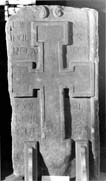
Object type: Grave-marker or -cover
Measurements: H./L. c. 104 cm (41 in); W. c. 53 cm (20.75 in); D. c. 18 cm (7 in)
Stone type: Medium-grained, massive yellow sandstone
Plate numbers in printed volume: Pl. 110.604
Corpus volume reference: Vol 1 p. 124
(There may be more views or larger images available for this item. Click on the thumbnail image to view.)
A (broad): One side is edged by a roll moulding inset from a flat edge. At the top are the remains of two wing-like features. Set centrally on the slab is a standing cross, type A3, in high relief. It is outlined by a raised flat-band moulding, and has a block base. The horizontal arms push into the edge moulding, which steps out around them. In the quadrants of the cross is a Latin inscription in Anglo-Saxon capitals. It reads:
(a) Upper two quadrants:
HIC II INSE
PUL II CRO
REQV II IESCIT
(b) Lower two quadrants:
COR II PORE
HERE II BERI
CHT II PRB'
HIC IN SEPULCRO REQUIESCIT CORPORE HEREBERICHT PR(ES)B(YTER) (Translation: `Here in the tomb rests Herebericht the priest in the body').
The two lowest lines of lettering are smaller and more carelessly laid out than the rest of the inscription. They also include a different form of `E'. On careful inspection of the stone it is clear that the surface below the last two lines has been rubbed down, so that one should accept Browne's suggestion that the stone has been re-used (Browne 1886a, 30).
B (narrow) and C (broad): Plain.
D (narrow) and E (top): Broken off.
This type of cross with square-ended arms is much favoured on slabs at Monkwearmouth and Jarrow (nos. 10-12). It is also found on the name-stone from Monkwearmouth (no. 4). However, this piece is by far the most assured and confident relief slab carving that has survived. It seems to represent a significant stage in the development of the relief slab and the free-armed crosses.
