Volume I: County Durham and Northumberland
Select a site alphabetically from the choices shown in the box below. Alternatively, browse sculptural examples using the Forward/Back buttons.
Chapters for this volume, along with copies of original in-text images, are available here.
Current Display: Monkwearmouth 08, Durham


Overview
Object type: Pair of door jambs
Measurements:
North side: H. 53.3 cm (21 in); W. 24.7 cm (9.75 in); D. 22.9 cm (9 in);
South side: Measurements identical
Stone type: Coarse-grained, massive (colour bonded) red/yellow sandstone
Plate numbers in printed volume: Pls. 112.612, 113.613, 115.616-617
Corpus volume reference: Vol 1 p. 125-126
(There may be more views or larger images available for this item. Click on the thumbnail image to view.)
Present Location
In situ in west entrance to porch/ tower of church
Evidence for Discovery
Longstaffe first noticed balusters in disused west porch in 1858. Lower part of doorway then completely buried, so that Longstaffe believed they marked recess rather than entrance. In 1866 restoration this area cleared inside and out and jambs below balusters first seen. Browne (1897) suggests that drawing he shows with balusters in position is imaginative restoration on his part, but he seems muddled over earlier reconstructed drawing in Browne (1886b), in which he showed lion arm-rests, nos. 15a-b, as abaci above balusters. For balusters see 8a-b under no. 14.
Church Dedication
St Peter
Present Condition
Very weathered
Description
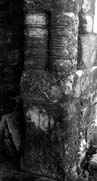
The decoration on both jambs is identical. On each the ornament is carved through uninterruptedly on the face of two stones which are set into the fabric in an upright and flat technique. On the upper flat stone are the necks of two reptilian creatures whose heads curve inwards and whose jaws interlace symmetrically at the base of the stone. The eyes are small, incised and almond-shaped while the beaked jaws are formed as two long slings (those on the north jamb are better preserved). On the larger upright slab below, the ribbon bodies follow the line of the edge of the stone, loop inwards at the base, cross in the centre and twist together until they reach the top of the stone, where the tails separate and curve out to the edge with fish-tail terminals.
Discussion
These creatures bear a superficial resemblance to those in manuscripts, such as Durham A.II.17, fol. 2r, and to those on Monkwearmouth 9 in their long sling-like beaks. However, although the head types can be compared with some in Insular manuscripts and Northumbrian metalwork, such as the Bamburgh fragment, the compositions and the tails are rather different. Such motifs can also be compared with the twisted reptiles on Aquitanian buckles (Åberg 1947, fig. 22, 1).
Date
Last quarter of seventh century
References
Longstaffe 1858, 94-5; (—) 1862-8c, figs. 1-2; Greenwell 1862-8, xlii-xliii; Johnson 1866, 363, fig. II; Boyle 1886, 48-9, pls. 4-5; Browne 1886b, 10, pl. I, 1; Allen 1887, 243-4; Allen 1889, 197; Boyle 1892, 541; Hodges 1893, 144, fig. on 145; Brown 1895, 251, figs. 19-20; Browne 1897, 106, 290-1, fig. 2; Patterson 1901, 76-8, figs. 1, 4; Hodgson 1906-11b, 169-70, pl. facing 168; Boutflower 1910, figs. on 148 and 157; Hodgkin 1913, 199; Howorth 1917, II, 282-3, pls. facing 282 and 298; Hall 1918-25, 44-5; Brown 1925, 124-5, figs. 57-9; Clapham 1930, 39, 50, 116, pl. 6; Rivoira 1933, 144, 151, fig. 546; Pfeilstücker 1936, 123, fig. 28; Hubert 1938, 103, pl. 14C; Colgrave 1944-53, 187; Gilbert 1947, 165; Fyson 1951-6, 242; Hodgkin 1952, fig. 51; Pevsner 1953, 187; Radford 1954b, 210-11, pl. 32D; Hyslop 1960, 36 and fig.; Fisher 1962, 92-3, 99-100, pls. 18, 21, fig. 6A; Gilbert 1964, 75, pl. 2; Cramp 1965b, 3; Taylor and Taylor 1965, 444, fig. 206; Taylor and Taylor 1966, 40-1, 51; Bruce-Mitford 1969, 23-4 and fig.; Taylor 1978, 741
Endnotes