Select a site alphabetically from the choices shown in the box below. Alternatively, browse sculptural examples using the Forward/Back buttons.
Chapters for this volume, along with copies of original in-text images, are available here.


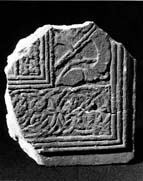
Object type: Incomplete panel
Measurements: H. 27 cm (10.6 in); W. 24 cm (9.5 in); D. 6.5 cm (2.5 in)
Stone type: Hartlepool and Roker dolomite
Plate numbers in printed volume: Pl. 121.656
Corpus volume reference: Vol 1 p. 126
(There may be more views or larger images available for this item. Click on the thumbnail image to view.)
This fragment represents one corner of what must have been an elaborately decorated piece. Only one carved face survives and the back and sides of the stone are plain.
A (broad): Edged with a wide flat-band moulding recessed from the carved surface. The outer zone of ornament is enclosed by a fine triple roll moulding; the inner zone is similarly enclosed but here there may also be a vertical division. In the outer zone the ornament is not subdivided by a moulding, but in the top right corner is part of a ribbon animal whose body tapers to a point and extends into a thin tail, which loops round its body and through the long sling-like beak which clasps the body. In the horizontal zone below are two registers of encircled pattern F. The circularity of the outer strands is emphasized by the junction bindings, which clip the circles together with a sharp angular bend. The strands are fine and sharply cut with a small chisel. The surviving interlace in the vertical panel in the inner zone is difficult to follow because it is worn and the strands densely packed. It has been reconstructed by Adcock (1974, pl. 6b) as a linked and twisted pattern.
This piece has been reconstructed by Adcock as a panel (1974, fig. 18A), into what she calls (ibid., 67) `the smallest symmetrical design which can be made logically and also accommodate the visible evidence'. It seems possible that this could have been a closure slab for shutting off the schola cantorum or sanctuary. On the other hand it is possible that it was part of an altar frontal or box shrine.
The ornament reflects the Insular taste which manifests itself on other stone fragments from this site, such as nos. 8, 17-18. The layout is not unlike a manuscript carpet page (Book of Durrow, fol. 192v), and the taste for encircled patterns linked by angular bends is also seen in the Book of Durrow, fol. 85v. Adcock (1974, 68-9) notes that encircled patterns and the fine-strand technique with a small unit measure are particularly common on Pictish slabs such as Meigle (Allen 1903, no. 5, fig. 314A). It is also found on Muiredach's cross at Monasterboice (Henry 1967, II, pl. 77).
