Select a site alphabetically from the choices shown in the box below. Alternatively, browse sculptural examples using the Forward/Back buttons.
Chapters for this volume, along with copies of original in-text images, are available here.


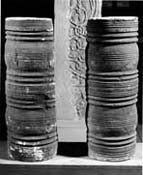
Object type: Thirty-five baluster shafts [1]
Measurements:
a-b: H. 57 cm (22.5 in); Diameter 21.6 cm (8.5 in)
c-f: Unobtainable
g: H. 24 cm (22.5 in); Diameter 21.6 cm (8.5 in)
h: H. 28.5 cm (11.2 in); Diameter 16 cm (6.3 in)
i: H. 21.5 cm (8.5 in); Diameter 16 cm (6.3 in)
j: H. 18 cm (7 in)
k: H. 18 cm (7 in); Diameter 16 cm (6.3 in)
l: H. 22.5 cm (8.9 in)
m: H. 30 cm (11.8 in); Diameter 16 cm (6.3 in)
n: H. 8.5 cm (3 in); Diameter 15 cm (5.9 in)
o: H. 29 cm (11.5 in); Diameter 21 cm (8.25 in)
p: H. 22 cm (8.6 in); Diameter 18 cm (7 in)
q: H. 29 cm (11.5 in); Diameter 14.5 cm (5.75 in)
r: H. 15 cm (5.9 in); Diameter 15.5 cm (6.1 in)
s: H. 22 cm (8.6 in); Diameter 15.5 cm (6.1 in)
t: H. 24.5 cm (9.6 in); Diameter 15 cm (5.9 in)
u: H. 25.5 cm (10 in); Diameter 17.5 cm (6.9 in)
v: H. 23 cm (9 in); Diameter 17 cm (6.7 in)
w: H. 20 cm (7.9 in); Diameter 16.5 cm (6.5 in)
x: H. 20 cm (7.9 in); Diameter 15.5 cm (6.1 in)
y: H. 25.5 cm (10 in); Diameter 17 cm (6.7 in)
z: H. 23 cm (9 in); Diameter 18 cm (7.1 in)
aa: H. 17 cm (6.7 in); Diameter 15.5 cm (6.1 in)
ab: H. 16.5 cm (6.5 in)
ac: H. 28 cm (11 in); Diameter 26.5 cm (10.4 in)
ad: H. 21.5 cm (8.5 in); Diameter 20.5 cm (8 in)
ae: H. 16 cm (6.3 in); Diameter 17.5 cm (6.9 in)
af: H. 11 cm (4.3 in)
ag: H. 7 cm (2.75 in)
ah: H. 7.1 cm (2.75 in)
ai: H. 13.5 cm (5.3 in)
j, l, ab and af-ai: Diameter incomplete
Stone type: Hartlepool and Roker dolomite. See also 8a-b.
Plate numbers in printed volume: Figs. 6-8; Pls. 118.627-628, 119.629-632, 120.633-648, 121.649-655, 121.657-662
Corpus volume reference: Vol 1 p. 128-219
(There may be more views or larger images available for this item. Click on the thumbnail image to view.)
The profiles can be grouped into sixteen types (c–d and e–f unobtainable):
Type i (Fig. 6): a–b, and perhaps also ag and ah
Type ii (Fig. 6): 8a–b (see above)
Type iii (Fig. 7): m
Type iv (Fig. 7): g, ai
Type v (Fig. 7): o
Type vi (Fig. 7): y
Type vii (Fig. 7): ac
Type viii (Fig. 7): ad
Type ix (Fig. 7): p
Type x (Fig. 7): v (variant)
Type xi (Fig. 8): q (variant)
Type xii (Fig. 8): h, j, u, and perhaps also k (all variants)
Type xiii (Fig. 8): x
Type xiv (Fig. 8): i, s, t, w, z, ab, and perhaps also aa and af (all variants)
Type xv (Fig. 8): l
Type xvi (Fig. 8): r, and ae (variant)
In both scale and decoration the free-standing balusters from Monkwearmouth are very varied. a and b (type i, Fig. 6) which are in the Durham cathedral collection are of similar height to the two pairs, 8a–b (type ii, Fig. 6), in situ at Monkwearmouth. a and b have shallow holes in the centre of each end and each has been cut with a sharp angular groove from top to bottom (Haverfield and Greenwell 1899, 71 and fig.). There are turning marks on the ends which are almost certainly caused by lathe turning, and the grooves are obviously a secondary phase of this turning. This pair of balusters is unweathered.
8a–b are very badly weathered but they are closely similar in profile and groove formula. The profiles are drum-like but swell slightly above and below the central band of close-set deep grooves. There are shallow grooves in threes, and deeper more sharply angled grooves in twos, and these match exactly within the pair (type ii, Fig. 6).
The pairs of half balusters, c–f, which were discovered turned face inwards in the west wall of the church in the 1866 restoration are not necessarily in situ. They belong to a type intermediate between those on the exterior and the other examples displayed in the church. It is difficult to be certain of the forms of c–f, but they appear to be carefully paired in each window. Of the twenty-two others displayed in the church no two complete examples have identical groove formulae. On the whole, these lack the rounded and chamfered mouldings of a and b, and are more angular. However, several such as r, s, t or z have holes at the end presumably for lathe turning. Some like o, g or z appear complete in themselves with projecting bands at the top and bottom and swelling curved outlines in between. Withers like l, x or t, although apparently complete, are not symmetrical. Those with fine closely spaced grooves such as v, p, m, and h are possibly lathe-turned also. It is possible, however, that some were shaped in a different way with a chisel which formed a profile with flattened rectangular mouldings, as against those which are sharply chamfered – such as i, l, r, t and s. Several have been cut away at the back, leaving a three-quarter rounded section, perhaps to set against a wall or window (as c–f).
The great variety of groove formulae in these pieces is puzzling, but the near conformity of the pairs which are complete and have been found together does indicate that these pieces could be turned out to a formula whether from a template attached to a lathe or from a chisel and template. The many other fragments (not included here) which were found in recent archaeological excavations on the monastic site indicate that such baluster shafts were a relatively common architectural feature. How they were used is difficult to decide. The only pair in situ flank an opening, and it is possible that such balusters could have flanked openings into side chambers or could have formed part of a balustrade or canopy around and above an altar. The grooves in a and b could be original features if they slotted into a low screen.
The diversity and the smaller scale of the Monkwearmouth pieces in comparison with those from Jarrow possibly indicate that they could have had a variety of functions. The origins of such lathe-turned shafts could, as has been postulated in the Introduction (p. 24), be seen in the wooden furniture of the barbarian Germanic aristocracy. However, stone prototypes exist in Gaul at Nouaillé and Poitiers, and, since these pieces have, like ab and 8a-b, fine incised lines in bands, the conception of stone balusters could have been imported by Gaulish masons. Wither sites in the north, such as Hart (no. 10) and Whitby (pl. 263, 1423), have produced balusters of drum-like type. It is possible therefore that the fashion, having been introduced there, spread to other centres. Moreover, it is possible that those pieces in which the profiles are flatter, such as types x-xii and xv (Figs. 7-8), could have been carved with a chisel at a later date in imitation of the lathe-turned earlier pieces.
