Select a site alphabetically from the choices shown in the box below. Alternatively, browse sculptural examples using the Forward/Back buttons.
Chapters for this volume, along with copies of original in-text images, are available here.


Object type: Furniture
Measurements:
Stone a: H. 41.9 cm (16.5 in); W. 59.7 cm (23.5 in); D. 21.6 cm (8.5 in)
Stone b: H. 38.1 cm (15 in); W. 57.2 cm (22.5 in); D. 21.6 cm (8.5 in)
Stone type: Medium-grained, massive yellow sandstone
Plate numbers in printed volume: Pls. 122.663-667, 123.668-672
Corpus volume reference: Vol 1 p. 129-130
(There may be more views or larger images available for this item. Click on the thumbnail image to view.)
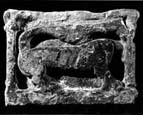
Stone a. A single slightly tapering block of stone has been carved on one broad and one narrow face with a lion in an architectural `cage', which is meant to be seen from the side and the front. The top has extensive traces of mortar; the back is hammer-dressed.
The animal is framed in a pair of columns with small block capitals and bases. The stone is so cut away that from the front it appears as if in a cage. The beast crouches rather uneasily, its haunch against the column on the left, its dominating tail turned over its back and taking up about a third of the `picture space'. Its back is deeply curved at the top (and the curve is filled by the thickening of the tail). Its front legs are braced and its head is bent sideways to its left, under the projecting ledge above. It has clawed feet but much of their detail is lost.
Stone b. A single block of stone has a lion carved in very high relief. The beast's two back haunches are carved almost free from the stone. It is standing with front legs slightly braced on a ledge and head bent and turned to its right, pressed against the upper block. It has a thick tail, the surface of which has been lost, but the punched outlines for it survive. The body is muscular and tapers towards the back haunches. The head has pointed ears and oval eyes. The claws of its front paws are realistically carved.
Clapham (1950) compares these stones with the stone thrones from the church of St Emmeram at Regensburg (Braun 1948, 810-11), and attempts a reconstruction. The pair could be reconstructed into a more elaborate arrangement than anything which survives elsewhere for its period. Clapham noted, too, that the pieces could not form part of a single piece of furniture since they were both left-hand sections. However, he convincingly placed them as part of the same `suite', namely one, the left side of the clergy bench, the other, the left side of the abbot's seat, which could have stood in the centre of the benches.
Stone b is slightly the smaller and is clearly meant to be looked at mainly from the side to which the beast's head is turned. Stone a, slightly the larger and with more architectural detail, presents a striking appearance both from the side and from the front. For these reasons I consider that a is more plausibly explained as the arm of the abbot's seat, and b as the arm-end of the clergy bench. Schramm (1954, 338-9) quotes the description of Solomon's throne (1 Kings 10, 18-20), which also had lion supports, so that there could have been some symbolic significance in these pieces which appealed to the Monkwearmouth/Jarrow builders. On the other hand furniture supported by lions is a well known antique type (Richter 1966, pls. 162, 579).
This set, when complete, would have formed the only composition we can compare with Early Christian work on the continent, although there is a smaller lion in a similar style at Hexham (no. 35).
