Select a site alphabetically from the choices shown in the box below. Alternatively, browse sculptural examples using the Forward/Back buttons.
Chapters for this volume, along with copies of original in-text images, are available here.


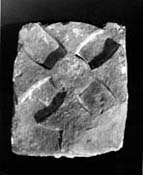
Object type: Architectural feature
Measurements: H. 36.5 cm (14.4 in); W. 30 cm (11.8 in); D. 15.5 cm (6.1 in)
Stone type: Hartlepool and Roker dolomite
Plate numbers in printed volume: Pl. 116.620
Corpus volume reference: Vol 1 p. 133-134
(There may be more views or larger images available for this item. Click on the thumbnail image to view.)
One face only is carved.
A (broad): A cross in high relief. The arms are nearest to E6 and taper sharply towards a large round centre. The upper and both horizontal arms touch the edge of the stone, whereas the lower is attached to a narrow stem.
The cross shape with arms of the E6 type but with a wide circular centre can be found in this area on what have been considered grave-markers of the overlap period. On the other hand, 28 (which is identical with this stone) appears to be properly bedded in with the wall, so that it could be part of the seventh-century church rather than an insertion marking the consecration of the eleventh-century tower. These two stones are clearly a pair and may perhaps be regarded as consecration or dedication crosses. However, are they consecration crosses for the original church or for the rebuilt tower? They are unique in the Northumbrian series in their little stems which support the lower arm of the cross, but their type of splayed arm with rounded end, E6, and large circular centre is found elsewhere at Heddon-on-the-Wall, Warden (no. 5) and Woodhorn (nos. 3-4); it also has some relationship with the shape of Birtley 3. I have been inclined to date all of them late, since the tendency to taper arms of this type sharply towards a large rounded centre is found in crosses which are demonstrably post-Conquest, such as at St Helen's, Kelloe, co. Durham. However, the identical shape of cross to these from Monkwearmouth occurs at Poitiers in the facade of the baptistery (Hubert, Porcher and Volbach 1969, pl. 48). The question of their date must therefore remain open.
