Select a site alphabetically from the choices shown in the box below. Alternatively, browse sculptural examples using the Forward/Back buttons.
Chapters for this volume, along with copies of original in-text images, are available here.


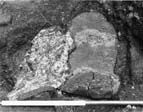
Object type: Round-headed grave-marker, reused as grave cover
Measurements: H. 82.5 cm (32.5 in); W. 45 cm (17.7 in); D. 10 cm (4 in)
Stone type: Medium-grained, massive yellow sandstone
Plate numbers in printed volume: Pl. 247.1370, 248.1371, 249.1376
Corpus volume reference: Vol 1 p. 244-245
(There may be more views or larger images available for this item. Click on the thumbnail image to view.)
Only one face is carved.
A (broad): A cross, type B6, is carved in relief on the upper portion of the stone which is rectangular with a rounded top. In the centre of the block and at the base of the lower arm or shaft is a large hole. The surface of the stone has been cut back to form the cross and is tooled with fine diagonal tooling. The original surface of the stone, however, is marked by fine circular grooving. This has been partly rubbed off on the cross itself and the shape of the arms is outlined by a fine incision. On the lower half of the stone the original surface is left, presumably because it was intended to set this in the ground. On the lower surface the curving grooves are particularly noticeable.
Appendix A item (stones dating from Saxo-Norman overlap period or of uncertain date).
This is an extremely important fragment, since the Newcastle cemetery excavations are the only ones in this area where gravestones have been discovered in situ. Moreover, the cemetery must predate the keep of the castle (see Discussion under 2). In addition, this stone demonstrates three phases of use which must be fitted in before that date.
The original use seems to have been as a millstone, either Roman or Saxon, since occupation of both periods is attested from this area. It had then been reshaped as a head- or foot-stone of the type found in situ in the excavations at Whitby abbey in the 1920s (Pl. 263, 1424).
It is unclear why the carving was taken beyond the hole. The carving of the cross and its outlines are very clear and unweathered, so that it is possible that it was never used as a head- or foot-stone, but that the stone broke across the hole in course of manufacture. The lower arm or shaft of the cross is not outlined in the same way as the other arms; perhaps it was considered that not much would be seen. The hole in the stone was then plugged (Pl. 247, 1370) and covered by mortar. It was then used as a grave-cover over a body whose feet were covered with smaller stones cemented on to the ground or to the cist below.
Since the stone was reused in a burial which must predate the keep (see Discussion under 2), it may well have been produced as early as the late eleventh century, a date which has been tentatively assigned to similar monuments such as Bolam 1 and Woodhorn 3.
