Select a site alphabetically from the choices shown in the box below. Alternatively, browse sculptural examples using the Forward/Back buttons.
Chapters for this volume, along with copies of original in-text images, are available here.


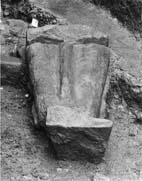
Object type: Grave-cover
Measurements: L. 94 cm (37 in); W. 53 > 29 cm (21 > 11.5 in); D. 27 > 20 cm (10.5 > 8 in)
Stone type: Coarse-grained, massive, micaceous yellow/ reddened sandstone
Plate numbers in printed volume: Pl. 249.1377-1378
Corpus volume reference: Vol 1 p. 245
(There may be more views or larger images available for this item. Click on the thumbnail image to view.)
Trapezoidal, with smoothly dressed surface.
A (top): The surface dips into the centre from either side and then rises to form a broad rounded moulding which tapers and is cut off at the narrower end of the stone.
B and D (long): Slightly splayed. B ends in a low flange c. 6 cm deep.
C (narrow end): Broken off.
E (broad end): A broad roll moulding runs right across.
Appendix A item (stones dating from Saxo-Norman overlap period or of uncertain date).
This stone, which has almost certainly been reused, was set between rough head- and foot-stones. It is possible that the piece was once part of a larger grave-marker and that the centre moulding could have been the stem of a cross, of which the head had been lost. However, it is not easy to parallel the profile of the moulding on the top of the stone in grave-markers of the tenth to twelfth century – the possible date bracket for this piece. Crosses are either incised (see Hexham 17), or are cut with straight sides from the flat surface of the stone (see Hexham 16). Moreover, the roll moulding suggests that this was perhaps originally an architectural fragment.
The stone was found lying directly on top of Newcastle 1, and had presumably been deposited at the same time. It was overlain by building debris associated with the construction of the keep. As this was built between 1168 and 1178, it provides a terminus ante quem for the whole assemblage.
