Select a site alphabetically from the choices shown in the box below. Alternatively, browse sculptural examples using the Forward/Back buttons.
Chapters for this volume, along with copies of original in-text images, are available here.


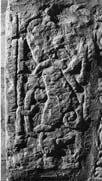
Object type: Incomplete cross-shaft
Measurements: H. 56 cm (22 in); W. 29.9 > 29.2 cm (11.75 > 11.5 in); D. 20.9 > 17.8 cm (8.25 > 7 in)
Stone type: Fine-grained, cross-bedded red sandstone
Plate numbers in printed volume: Pl. 205.1167-1168
Corpus volume reference: Vol 1 p. 209
(There may be more views or larger images available for this item. Click on the thumbnail image to view.)
A (broad): The shaft is edged by a single pick-outlined grooved moulding which encloses an extended crouching animal. This, as is clear from the taper of the shaft, originally faced up the shaft. The animal is surrounded by flat strap-like extensions from its head and tail but because of the damage to the shaft it is impossible to be sure of their organization. The head has a squared-off muzzle, an oval eye with a dot centre, and an awkwardly placed hook spiral by its front leg.
D (narrow): The shaft is edged by a single grooved moulding which encloses the remains of three widely spaced double free rings and long single opposing diagonals.
The difference in stone, the crude, shallow, grooved and picked technique of cutting, as well as the animal ornament, set this piece apart from the rest and seem to put it after the monastery had ceased to exist. It is possible that this shaft had been influenced by Anglo-Scandinavian animal ornament, although the head type derives from Hiberno-Saxon beasts.
