Select a site alphabetically from the choices shown in the box below. Alternatively, browse sculptural examples using the Forward/Back buttons.
Chapters for this volume, along with copies of original in-text images, are available here.


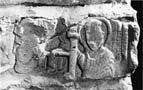
Object type: Fragment of cross-shaft
Measurements: H. 14 cm (5.5 in); W. 24.1 cm (9.5 in); D. 15.2 cm (6 in)
Stone type: Coarse-grained, massive reddish sandstone
Plate numbers in printed volume: Pl. 203.1162-1163
Corpus volume reference: Vol 1 p. 209-210
(There may be more views or larger images available for this item. Click on the thumbnail image to view.)
The shaft is edged by a fine double roll moulding.
A (broad): On the left is a frontal angel with right arm turned slightly and extended behind a column. The two fingers of the hand are raised in blessing. The angel has a small dished halo. The drapery folds are indicated by a series of deep V-shaped grooves on its left arm, and concentric grooves for the tightly fitting sleeves of its right area. The column has a rounded block capital. On the other side of the column is a horizontal bar-like feature with a heavy fold of drapery looped over it.
B (narrow): Part of a plant-scroll. The node has a triple ridge and from it sprout two fine stems which interlace. Below are two pendant leaf-flowers.
In stone type and the technique of carving, particularly of the plant-scroll, this shaft most closely resembles the cross-head (no. 10) and it may well be that they were once part of the same monument. The scene depicted is most probably an Annunciation, with Mary seated on the left, and the architectural frame indicating an interior. The use of architectural frames is typical of the midland and Deiran schools of the ninth century (Collingwood 1927, 70-6, and Cramp 1978a, 9, draw parallels with Otley, Yorkshire). The gesture whereby the angel's hand extends behind the column is identical with that of Christ at Aldborough, Yorkshire (Collingwood 1927, fig. 32). The deeply grooved drapery and rounded figure type is, however, more in the Bernician style, and may be compared with Jarrow and Rothbury. The leaf-flowers can be found at centres as widely dispersed as Masham, Yorkshire, and Jarrow.
