Select a site alphabetically from the choices shown in the box below. Alternatively, browse sculptural examples using the Forward/Back buttons.
Chapters for this volume, along with copies of original in-text images, are available here.


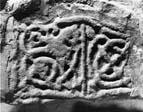
Object type: Fragment of cross-arm
Measurements: H. 21.6 cm (8.5 in); W. 25.4 cm (10 in); D. 17.2 cm (6.75 in)
Stone type: Coarse-grained, massive reddish sandstone
Plate numbers in printed volume: Pl. 206.1186-1187
Corpus volume reference: Vol 1 p. 213-214
(There may be more views or larger images available for this item. Click on the thumbnail image to view.)
Arm, type D9 or D11.
A (broad): This face, possibly the left horizontal arm, is surrounded by a fine double roll moulding and subdivided by a single roll moulding into two panels. (i) In the end panel is an animal seen in profile. Its head is bent slightly to eat a scroll. It has a rounded head with a small pointed ear and its jaws are slightly open. It has a sharply everted wing with curling tip. Its tongue is extended and passes through its prancing front legs to join with its tail. Both tongue and tail extensions pass under and over the back legs and haunches of the beast and curl around the wing. One strand ends with a curling tip. The back haunches are almost disassociated from the body. (ii) In the central panel is a knot of plant-scroll, of which the crossing strands end in small plain pointed leaves. The strands form one unit of turned half pattern F with surrounding outside strands.
F (narrow): Possibly the under-side. It has a panel of closed circuit pattern D with bar terminal, surrounded by a fine roll moulding.
The division of the cross-head into panels can be found at Hoddom, Dumfriesshire, and Masham, Yorkshire. The style of animal ornament and the knotted scrolls seem rather to have evolved from metalwork and manuscripts motifs such as the Re, Nord Trøndelag mount and the Leningrad Gospels, fol. 12v. The leaf-knot motif is found on the Wallingford sword and the Aethelwulf ring (Wilson 1964, 82, pls. 6, 19). The motif is also found on Norham 2.
