Select a site alphabetically from the choices shown in the box below. Alternatively, browse sculptural examples using the Forward/Back buttons.
Chapters for this volume, along with copies of original in-text images, are available here.


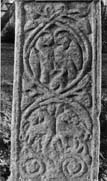
Object type: Cross-shaft
Measurements:
H. 134.6 cm (53 in); W. 46 > 35.5 cm (18 > 14in); D. 25.4 > 17 cm (10 > 6.7 in)
Plinth: H. 15.2 cm (6 in); W. 47 cm (18.5 in); D. 25.4 cm (10 in)
Stone type: Coarse-grained, bedded yellow sandstone
Plate numbers in printed volume: Pls. 207.1192; 208.1193-1194, 209.1195-1196
Corpus volume reference: Vol 1 p. 214-215
(There may be more views or larger images available for this item. Click on the thumbnail image to view.)
The lower half of a rectangular cross-shaft with a collar and wider plinth at the bottom. The faces are enclosed in a fine double roll moulding and the collar, which divides off the complete lower section, is grooved so as to give the appearance of a binding held together with studs. There are five such studs on each broad face and four on each narrow.
A (broad): Above the binding or collar a small portion of a tangled scroll with short triangular leaves survives. Below, the face is entirely covered by an inhabited scroll composed of two interlaced medallions. At the top, the four strands, which terminate in short triangular leaves with central ridge, are tied together in a bow. Below, the medallion throws off two small tendrils which a pair of birds grip in their beaks. It seems likely the tendrils terminated in berry bunches. The birds are half frontal with one displayed wing. Their legs cross and disappear into a looped leaf or berry bunch at the base of the medallion. From the crossings of the medallion below sprout four short triangular leaves with sunken centres. In the medallion are two affronted animals with canine heads. Their jaws are open, biting at a berry bunch. Their tails are hooked round the scroll to join the berry bunch. All their legs are seen. The two back legs straddle the scroll and one of the front legs ofeach creature crosses the other's. At the top a pair of short triangular berry bunches hangs behind their heads. The base of the medallion springs from a single root with two simple side scrolls enclosing short triangular berry bunches.
B (narrow): The surviving section above the binding appears to be plain. Below, the face is filled by five volutes of a combined simple and spiral scroll which terminates in a pair of short triangular leaves. Each volute encloses a rounded berry bunch and is divided by a small round bud. From each volute hangs a short triangular leaf.
C (broad): Nothing intelligible survives above the binding. Below, the face is entirely filled with five volutes of a side linked scroll. Each encloses well shaped triangular berry bunches. The stems spring from a single rounded root and each pair is divided by small triangular leaves, buds or flowers.
D (narrow): This face is filled with a combination trail and simple scroll. The top branches out into a two element spray and a single grape bunch of a rounded triangular form. Below are two more such bunches and then two simple scrolls with drop leaves divided by buds. The scroll springs from a single solid root. Above the binding the face appears to be plain.
The form of the monument is unique, although one can see this tendency towards the two-part collared shaft popular elsewhere in the ninth century, at, for example, Otley and Ilkley, both in Yorkshire, and Addingham, Cumberland. The architectural shape with a plinth appears in a later form at Walton, Yorkshire. The narrow section with elaborate mouldings, and the tendency for the scrolls to change their organization on the same length seem to be typical of ninth-century Northumbrian work. There are clear links with the Hexham school in the combination of fine wiry medallion scrolls on the broad face, and simple scrolls on the side (Collingwood 1927, 356). It is also possible that the idea of the heavy stranded or pelleted band is derived from the capping of Hexham 1. The elaborately side linked scrolls are unique but the tendency to join scrolls in this way is found on the Kirkoswald brooch deposited c. 835 (Wilson 1964, pl. 19). The paired birds and beasts with their tendency to merge with the scroll perhaps reflect a more southerly influence which is first found in late eighth-century manuscripts such as the Vespasian Psalter, but then spreads to sculpture in Mercia and Deira (Introduction, p. 16). Despite the worn condition of this stone it was clearly elegantly and inventively designed and competently carved. It is difficult to see it as late as Collingwood does.
