Select a site alphabetically from the choices shown in the box below. Alternatively, browse sculptural examples using the Forward/Back buttons.
Chapters for this volume, along with copies of original in-text images, are available here.


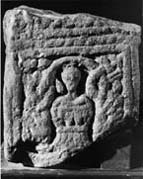
Object type: Upper part of cross-shaft
Measurements: H. 39.4 cm (15.5 in); W. 29.8 > 27.9 cm (11.25 > 11 in); D. 20.3 > 19.1 cm (8 > 7.5 in)
Stone type: Coarse-grained, massive yellow sandstone
Plate numbers in printed volume: Pl. 210.1197-1200
Corpus volume reference: Vol 1 p. 215-216
(There may be more views or larger images available for this item. Click on the thumbnail image to view.)
The faces are surrounded by thick double roll mouldings.
A (broad): Above the figures panel is a composite moulding with pellets, roll, and rough cable. Below is a frontal figure standing under a single arch which sprouts from thick tangled uprights. The figure has an egg-like head, rather rounded shoulders and is dressed in a short belted tunic. He holds a book against his chest. There could be a bird on his right shoulder.
B (narrow): The projecting collar is formed by a triple roll moulding with roughly pecked outlines. The broad flat-band moulding encloses three pairs of Stafford Knots (simple pattern F).
C (broad): On the left stands a figure with head in profile and body three-quarters turned. He is either wearing a hat or has very long hair which is knotted at his neck and falls down his back. One hand seems to be attached to a small quadruped whose front feet and muzzle touch the body of a figure on the right. This figure is frontal, and carries a club or a horn in his right hand. He wears a short tunic. Between the heads of the two figures is a roughly round object with two irregular holes in it.
D (narrow): The projecting collar carries a roughly picked straight line pattern (step 1) and a double roll moulding. Below are four pairs of Stafford Knots (simple pattern E).
This shaft was recognized when it was first published as being closely related to Tynemouth 2, possibly from the same hand or the same workshop (Hastings and Romans 1946). The style of cutting is the same and the iconography of face A appears to be the same [1]. The possible bird is not on the Tynemouth fragment, but there the figure is complete and seems to be standing on the heads of two beasts whose bodies develop into the canopy. The canopy at Tynemouth is tree-like, or could possibly be thought of as flame-like, but at Ovingham it is an anonymous dense mass. Hastings and Romans see the figures as orantes, but they clearly seem to be holding an open book with arms outstretched – a curious gesture which is repeated on the Durham cross-heads (nos. 5-7) and on Aycliffe 1, 3, 7 and 13. The figure at Tynemouth standing on two beasts could be derived from the same sort of model as produced the Christ in Majesty scenes on the Ruthwell and Bewcastle crosses. On the other hand it could represent some figure such as David or Samson with a lion. If the animals are less important than the tree-like canopy then it could represent some secular or mythological scene. The two figures with the beast on the other broad face were interpreted by Hastings and Romans as a hunting scene; the figure on the left holding a leashed hound, that on the right holding a club. More recently it has been interpreted by Richard Bailey as a Ragnarök scene in which the left-hand figure is Loki bursting his bounds, the central animal the wolf Fenrir about to swallow the sun, and the figure on the right Heimdall with his horn (Bailey 1980, 133, 253, fig. 24).
This interpretation has the merit of including within the interpretation the central roundel which otherwise might have to be seen as a space filler, such as the circle under the legs of the centaur on face C of Tynemouth 2. There seems little doubt that the figure style of this cross has links with the Anglo-Scandinavian sculptures of the area between Durham and the Tees (Introduction, p. 22). However, I feel that these depictions are so crude that it is difficult to be certain that any one interpretation is correct. It could just as well be a scene in which the figure on the left is David, the animal in the centre is a lion, and on the right the figure could represent Goliath with a club. Perhaps both Christian and Scandinavian mythologies were present. The simple pattern E plaits are commonplace in all periods of sculpture but the step pattern is more common in late Northumbrian sculpture.
