Select a site alphabetically from the choices shown in the box below. Alternatively, browse sculptural examples using the Forward/Back buttons.
Chapters for this volume, along with copies of original in-text images, are available here.


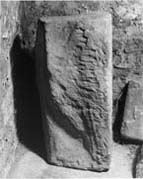
Object type: Part of cross-shaft [1]
Measurements: H. 68.5 cm (27 in); W. 19 cm (7.5 in); D. (max.) 29.2 cm (11.5 in)
Stone type: Coarse-grained yellow sandstone
Plate numbers in printed volume: Pl. 128.701-704
Corpus volume reference: Vol 1 p. 135
(There may be more views or larger images available for this item. Click on the thumbnail image to view.)
A and C (broad) and D (narrow): Carving obliterated.
B (narrow): Enclosed in a wide grooved moulding are two motifs not separated by a horizontal moulding. Athe top are two large single twists, below, a six-strand plain plait. The hole pattern and the strand width are irregular but there is some attempt at modelling.
The upper motif could be part of a simple twist pattern or two twisted serpents. The plain plait is quite unlike the other panels of plain plait with broad flat strands on 5 or 7. This style of cutting most resembles 8, face C.
