Select a site alphabetically from the choices shown in the box below. Alternatively, browse sculptural examples using the Forward/Back buttons.
Chapters for this volume, along with copies of original in-text images, are available here.


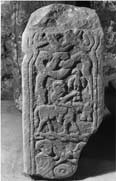
Object type: Part of cross-shaft and -neck [1]
Measurements: H. 81.25 cm (32 in); W. 33 cm (13 in); D. c. 25.4 cm (10 in)
Stone type: Fawn sandstone
Plate numbers in printed volume: Pl. 130.710-712
Corpus volume reference: Vol 1 p. 136-137
(There may be more views or larger images available for this item. Click on the thumbnail image to view.)
A (broad): The face is outlined in a broad outer and narrow inner grooved punch-outlined moulding. At the top are the pointed terminals of a six-strand median-incised plait. Below is a large knotted snake whose head and tail form a canopy over the rider below. A horseman faces right, holding a bird on his extended left hand and the halter of his horse in his right. He is shown in profile and is either bare-headed or wears a tight-fitting cap, his eyes are punched with a lightly modelled surround and he appears to have a drooping moustache. He wears voluminous short breeches. The bird on his hand is frontal with head turned to the left. It has a curved beak, punched eye, and drooping extended wings. The horse is shown in motion. It has a squared-off muzzle, a punched eye, and a long tail; there are possible indications of genitals. Dividing these figures from the scene below is a horizontal twist. The lower scene shows the remains of two figures. The one on the left is a woman, facing right, but with head turned towards the front. She holds a horn to the lips of the person opposite. She has smooth wig-like hair. Her eyes are punched and modelled. She wears a pleated over-garment cut away to a point. The rest of her dress is lost. Opposite her is part of the figure of a man in the act of drinking. His right hand supports the horn. His left presumably held the round shield which is prominently displayed between the figures. He is bare-headed and has a punched eye.
B (narrow): Little survives of this face. The chamfered neck of the cross is uncarved; on the left of the shaft are wide outer and narrower inner punch-outlined mouldings. These enclose a panel of what seem to be ribbon animals, but their organization is not clear.
C (broad): The detail on this face is much broken and worn. At the top may be an interlace motif; below are two figures, who may either be facing each other, or walking in procession. Only the one on the right is clear. He faces left and is shown in movement. He appears to be bare-headed and is of the same facial type as the drinker on the opposite side. He carries a round shield and wears a short tunic. Only the legs and the shield of the left figure are visible. Below is a panel of median-incised plaitwork, whose thick strands terminate in free spirals.
D (narrow): This is the least worn face. The chamfered neck of the cross is uncarved. Below, enclosed in a wide outer and narrower inner punch-outlined moulding is a ring-chain (G.I., fig. 26, cvi). The strands are median-incised and terminate in a double twist.
The rider on face A holding a bird and with a serpent above is different from most of the horsemen of the Anglo-Scandinavian period in this area. At Gainford (no. 4) and Hart (no. 1) the riders hold spears and at Chester-le-Street (no. 1), which is the nearest in type to this (Introduction, p. 29), the rider seems to wear a helmet and carries a shield. The bird and serpent are common attributes of the god Óðinn, so that he could be depicted here. Lang (1972) has suggested that whether he is Óðinn or a heroic warrior, this rider could be related to the scene below; Lang compares the iconography with Gotlandic picture-stones, such as Klinte Hunninge, where a mounted warrior is welcomed by a woman bearing a horn. On the whole, these two scenes at Sockburn appear as quite distinct episodes. In the one the horseman holds a bird; in the other the man holds a shield. However, there seems an undeniable link here with Scandinavian iconography, and one may compare the cross from Leeds (Collingwood 1927, fig. 193), on which is depicted a figure with a bird, or that from Staveley, Yorkshire (ibid., fig. 190), where there is a figure with a bird and horn, and armed men with spears and a dog below. It is difficult, however, to be certain whether we have secular narrative or religious narrative scenes on this piece. The abstract ornament, in particular the ring-chain and the curling tendrils of the interlace terminals, is also of Scandinavian type.
