Select a site alphabetically from the choices shown in the box below. Alternatively, browse sculptural examples using the Forward/Back buttons.
Chapters for this volume, along with copies of original in-text images, are available here.


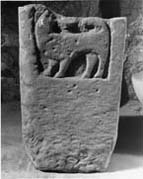
Object type: Lower part of cross-shaft [1]
Measurements: H. 62.25 cm (24.5 in); W. 20.25 cm (8 in); D. 35 cm (13.75 in)
Stone type: Medium-grained yellow sandstone
Plate numbers in printed volume: Pl. 129.706-709
Corpus volume reference: Vol 1 p. 137
(There may be more views or larger images available for this item. Click on the thumbnail image to view.)
A (broad): Set in a panel from which the background has been deeply carved is a quadruped, facing left. It stands stiffly with all four legs showing. Its head is turned back over its back and its tail curved forward.
B (narrow): Deeply carved in an incised technique is the base of a broad triquetra knot.
C (broad): Two pairs of legs are carved on the base of a deeply inset panel with a broad band surrounding it.
D (narrow): No carving on the surviving part.
The smooth, almost polished, dressing of the stone and the deep carvings of simple animal forms, together with the triquetra on face B, can all be paralleled on 7, where the animals have the same curious stance with legs braced. The same technique of cutting and the same backward-looking animal is also seen at Brompton (Durham cathedral, catalogue no. LVI). Bailey (1980, 185-6) has claimed that these Brompton and Sockburn pieces were produced by the same template.
