Select a site alphabetically from the choices shown in the box below. Alternatively, browse sculptural examples using the Forward/Back buttons.
Chapters for this volume, along with copies of original in-text images, are available here.


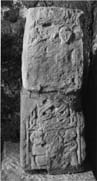
Object type: Part of cross-shaft, in two pieces [1]
Measurements: H. 89 cm (35 in); W. 28 cm (11 in); D. 35.5 cm (14 in)
Stone type: Medium-grained yellow sandstone
Plate numbers in printed volume: Pls. 132.720-721, 133.724-725
Corpus volume reference: Vol 1 p. 137-138
(There may be more views or larger images available for this item. Click on the thumbnail image to view.)
The faces are edged by broad flat-band and narrower inner roll mouldings.
A (broad): On the upper section there appear to be two figures. On the left the figure of a man faces right and reaches out with his hands towards a woman, who is frontally posed. Her hair is pulled back smoothly and her features are delicately conveyed. This scene is divided from that below by a four-strand median-incised plain plait surrounded by a twist frame. In the lower section are two figures facing each other. The man on the left appears to be seated in a high-backed chair. His head is three-quarter turned and he seems to be playing a lyre-like musical instrument. The man on the right stretches his hands down and his right leg is extended forwards. Both have well modelled features with lightly punched eyes.
B (narrow): The overhanging chamfered moulding partly survives at the top. The face is covered by a widely spaced ring-chain with median-incised strands (G.I., fig. 26, cvi). The uppermost link is in the form of an animal mask with round eyes and round hollowed ears.
C (broad): The face is covered by a broad median-incised six-strand plain plait. The two loose terminals at the top end in animal heads.
D (narrow): The upper part of the shaft has been dressed off. Below is a pattern of median-incised ring-chain in which each element is pushed closely together (G.I., fig. 26, cvi).
This piece is clearly linked with Sockburn 3, both in the ornamental scheme(?) of figures, ring-chain, and bold plain plaitwork and dividing twist, and in the style of carving, in particular of the figures. They are so similar they could have been carved by the same man.
