Select a site alphabetically from the choices shown in the box below. Alternatively, browse sculptural examples using the Forward/Back buttons.
Chapters for this volume, along with copies of original in-text images, are available here.


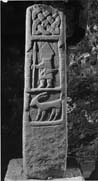
Object type: Part of cross-shaft [1]
Measurements: H. 115.5 cm (45.5 in); W. 28 > 23 cm (11 > 9.75 in); D. 20.25 > 17 cm (8 > 6.75 in)
Stone type: Medium-/coarse-grained yellow sandstone
Plate numbers in printed volume: Pl. 134.726-729
Corpus volume reference: Vol 1 p. 138
(There may be more views or larger images available for this item. Click on the thumbnail image to view.)
Each panel is deeply recessed leaving a plain flat-band moulding.
A (broad): (i) A panel of six-strand plain plait. The strands are closely packed together. (ii) The figure of an armed man facing left. With one hand he holds a spear upright. His head has been tooled away, but he seems to have worn a sharply pointed helmet. At his waist is a sword with closely curving guards, the pommel being broken away. (iii) A stag facing left. The lines of its antlers are lightly conveyed and its long legs are braced against the right border. The panel is edged below by an incised line.
B (narrow): Filled by a Como-braid, which terminates in a single loop flanked by two pellets.
C (broad): (i) A panel of six-strand plain plait, the mirror image of the panel on A. (ii) A panel of two closed circuit loops, median-incised. (iii) A quadruped facing right. Its head is canine with a triangular ear; its tail is curled forward over its back. Its legs are braced against the frame, and its testicles are depicted.
D (narrow): (i) A panel of Como-braid. (ii) A triquetra knot.
This piece is clearly linked with 4. There is the same technique of deeply recessed cutting and smoothly dressed surface, the same type of backward-looking animal on one broad face, figural carving on the other, and a triquetra terminal on one narrow face. The warrior with pointed helmet can be paralleled at Staveley (Collingwood 1927, fig. 190) and Middleton (Bailey 1980, pl. 14), and the stag, Como-braid and backward-looking canine at Brompton (Haverfield and Greenwell 1899, no. LVI) (Introduction, p. 30).
