Select a site alphabetically from the choices shown in the box below. Alternatively, browse sculptural examples using the Forward/Back buttons.
Chapters for this volume, along with copies of original in-text images, are available here.


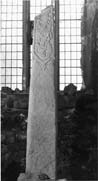
Object type: Cross-shaft [1]
Measurements: H. 211 cm (71 in); W. 37 > 24 cm (14.5 > 9.5 in); D. 23 > 13.25 cm (9 > 5.25 in)
Stone type: Medium-grained yellow sandstone
Plate numbers in printed volume: Pls. 135.730-732, 136.733-736
Corpus volume reference: Vol 1 p. 138-139
(There may be more views or larger images available for this item. Click on the thumbnail image to view.)
The faces are edged with baluster ornament.
A (broad): The baluster edge at the bottom meets a pair of upturned animal heads with pointed ears and round eyes. These are attached to a swag which falls in a pointed loop to terminate in a fox-like mask with round eyes and sharply pointed ears. Below the upturned heads are two other small fox-like masks in high relief. The frame encloses a procession of extended animals. The foremost has lost its head but its two front legs are extended and bent into a running position. Its ribbon body crosses over and under that of the animal behind and then disappears. Its tail however develops into a large curving form with fish-like tail. The second animal is also shown in a running position. Its ribbon body disappears behind the creature below and appears again with a short curling tail. Its back leg extends to meet its head extension. It has pointed open jaws with a fang, and a round eye. The neck and head of the lower creature appear to rear up from the fish-like terminal but it is so closely engaged with the animal in front that it is difficult to unravel the composition. It has pointed jaws, a fang and round eyes, and its short head extension curls loosely over its back.
B (narrow): The base of the panel is enclosed by a swag terminating in a fox-like mask rather cruder than on A, with the same upturned animal heads and modelled fox-like masks. These enclose a clever composition of simple pattern E units. At the top they are bound into ring junctions; at the base the four strands blend together into a thickened pointed terminal.
C (broad): This face is enclosed at the bottom by a similar animal loop to those on the other faces, but the four panels are separately framed with flat-band mouldings, which split into two strands at the corners to create the impression of a knot. (i) A square key pattern (Allen 1903, no. 1000). (ii) A six-strand plain plait with rounded modelled strands. (iii) A quadruped facing right, cut in deep relief. It is shown in a slightly rearing position with two bent front legs, and the back leg crouched. Its jaws are pointed and fanged and it has a large splendidly plumed tail. (iv) A shield-shaped panel of key pattern (Allen 1903, no. 1000).
D (narrow): The animal loop and baluster edging enclose a panel of changing plait. From a large free ring at the top, single registers of turned pattern C and simple pattern F develop; then a single spiralled pattern A element; and finally two more registers of turned pattern C.
This is an extraordinarily inventive cross which seems to have links in many directions. The baluster edging is paralleled at Great Stainton (no. 1), which also has key patterns like the top panel of face C here. The inset quadruped is like other Sockburn creatures, but rather more lively. The small modelled animal terminals are like the Durham grave-cover (no. 11), while the cross shape and the swag terminating in fox-like masks is exactly paralleled on Unknown Provenance 2. The swag is found at Coniscliffe (no. 6). The panel of six-strand plait is also found at Brompton. If we consider that the animal ornament on this shaft is a rendering of Jellinge ornament whilst that ornament was still current, it must be early in the Sockburn series, and the small animal terminals, like those on the Durham grave-cover, must have remained in fashion for a long time in the area.
Alternatively it could be an archaizing piece. However, wherever it belongs, it seems to indicate a range of contacts and styles, none perfectly assimilated. Its large scale and form, which seems to be derived from the round shafts of the western midlands or north-west, could be innovations in this area, although the Coniscliffe layout with its small Anglo-Scandinavian figure, could well be earlier. The manner of dividing the decorated from the undecorated part of the shaft by a looped swag and animal head could be derived from Anglo-Scandinavian art.
