Select a site alphabetically from the choices shown in the box below. Alternatively, browse sculptural examples using the Forward/Back buttons.
Chapters for this volume, along with copies of original in-text images, are available here.


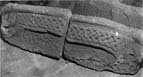
Object type: Hogback, in two joining pieces [1]
Measurements: L. 142.3 cm (56 in); W. 33 cm (13 in); D. 47 > 37 cm (18.5 > 14.5 in)
Stone type: Medium-grained yellow sandstone
Plate numbers in printed volume: Pl. 142.759-760
Corpus volume reference: Vol 1 p. 141
(There may be more views or larger images available for this item. Click on the thumbnail image to view.)
Type d, extended niche. The ridge is flat and surrounded by a grooved moulding, which encloses a straight line pattern, meander 2. The ridge terminates at each end in the jowls of two end beasts. Both are shown with four legs, the front legs raised to touch the jowls, the hind legs, where they survive, clasping the sides and sharply angled. The hind legs have four toes, the fore legs, five. The heads are treated in some detail: the jaws are elongated and the nostrils indicated by punch marks; the eyes are pointed ovals, and the ears are pointed and lightly moulded.
A (long): Below the ridge and extending to the front paws of the end beast is a panel of four-strand plain plait with broad flat strands. Below the panel is an extended niche, the curving top of which is marked by a rough moulding.
B and D (ends): Dressed but not carved.
C (long): Below the ridge is a band which has been plainly and smoothly dressed. Inset below in a pick-marked panel is a band of plain plait as on A. Below this again the stone is dressed smooth, but so hacked back that it is impossible to see whether there was a niche.
This type of hogback has a very localized distribution (Brompton, Osmotherley and Sockburn: Lang 1967, 380-1). This particular example is almost identical with Brompton.
