Select a site alphabetically from the choices shown in the box below. Alternatively, browse sculptural examples using the Forward/Back buttons.
Chapters for this volume, along with copies of original in-text images, are available here.


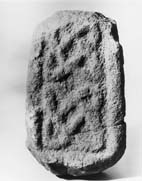
Object type: Incomplete cross-shaft
Measurements: H. (max.) 30.5 cm (12 in); W. 17.8 > 15.2 cm (7 > 6 in); D. 16.5 > 14 cm (6.5 > 5.5 in)
Stone type: Coarse-grained grey sandstone
Plate numbers in printed volume: Pl. 220.1246-1249
Corpus volume reference: Vol 1 p. 225
(There may be more views or larger images available for this item. Click on the thumbnail image to view.)
The fragment is edged by a crude roll moulding which returns along the base of the fragment.
A (broad): Covered by two disassociated knots composed of two closed circuit loops.
B (narrow): Part of a continous four-strand plain plait.
C (broad): Two opposed simple pattern E elements linked by long diagonals.
D (narrow): Part of a closed circuit two-strand twist.
Patterns with closed circuit loops are common on Anglo-Scandinavian and late Anglian monuments such as Ovingham 2. The closed circuit twist is paralleled at Sockburn and Lythe (Collingwood 1927, fig. 173); the pattern E loops with long diagonal strands are also found on late cross-heads, as at Hexham (no. 11).
