Select a site alphabetically from the choices shown in the box below. Alternatively, browse sculptural examples using the Forward/Back buttons.
Chapters for this volume, along with copies of original in-text images, are available here.


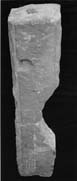
Object type: Part of plain cross-shaft, in two joining pieces
Measurements: H. 145 cm (57 in); W. 26 > 24 cm (10.25 > 9.5 in); D. 20 > 19 cm (7.9 > 7.5 in)
Stone type: Medium-grained, massive yellow sandstone
Plate numbers in printed volume: Pls. 215.1226, 216.1227-1228
Corpus volume reference: Vol 1 p. 222
(There may be more views or larger images available for this item. Click on the thumbnail image to view.)
The faces are plain and smoothly dressed, edged by a single roll moulding. There are socket-holes in three faces, which seem to be secondary, and part of the shaft has been roughly hollowed out to form an arch. It seems to have served as a door lintel.
Such plain shafts can be early as at Whitby (Peers and Radford 1943) or very late (Lindisfarne 45). However, since there has been a persistent tradition that this is the site of the battle of Heavenfield, where Oswald erected the first wooden cross in Northumbria, any subsequent stone cross at this site might, like the modern monument, have been plain to resemble wood. The socket in 2 does not seem to be of the right dimensions to fit this cross but it could have held a wooden monument. There seems to have been a series of crosses on the site, since the church also houses part of a magnificent thirteenth-century stone crucifix.
