Select a site alphabetically from the choices shown in the box below. Alternatively, browse sculptural examples using the Forward/Back buttons.
Chapters for this volume, along with copies of original in-text images, are available here.


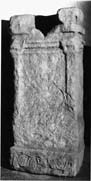
Object type: Cross-base
Measurements: H. (max.) 142.2 cm (56 in); W. 60 cm (23.5 in); D. 37.5 cm (14.8 in) Socket: 24x22x22> 14 cm (9.5x8.7x8.7> Sin)
Stone type: Medium-grained, massive yellow sandstone
Plate numbers in printed volume: Pls. 217.1229-1230, 218.1231-1232
Corpus volume reference: Vol 1 p. 222
(There may be more views or larger images available for this item. Click on the thumbnail image to view.)
Roman altar in which the top has been recut to form a cross-socket. The socket has an internal ledge in order to hold the shaft more firmly.
A (broad): The lettering and ornament have been obliterated but at the base there is a vine trail with triangular berry bunches and triangular hollow cut leaves.
B (narrow): A vine plant which springs from a single root and develops into a bush (probably Roman).
C (broad): Broken away.
D (narrow): A long-handled patera (Roman).
It is not possible to say whether this reused Roman piece held originally a wooden or stone cross. The socket could not have fitted the plain cross-shaft (no. 1). It seems significant, however, that there is a vine-scroll on this base. The scroll on the narrower face could well be Roman, but the horizontal trail on the base moulding of the broad face could be Anglo-Saxon. The nearest parallel to this form of grape bunch and leaf type is at Hexham, and it is possible that carvers from that centre recut the socket. It is also interesting to speculate whether what appears to be the Roman plant-scroll could have affected the Hexham school.
