Select a site alphabetically from the choices shown in the box below. Alternatively, browse sculptural examples using the Forward/Back buttons.
Chapters for this volume, along with copies of original in-text images, are available here.


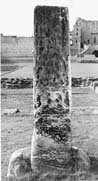
Object type: Incomplete cross-shaft (the Monk's Stone)
Measurements: H. 193 cm (76 in); W. 45.7 > 30.5 cm (18 > 12 in); D. 30.5 > 22.9 cm (12 > 9 in); Broken socket c. 7.8 cm (3 in) square
Stone type: Coarse-grained, massive yellow/grey sandstone
Plate numbers in printed volume: Pls. 221.1258-1259, 222.1260, 223.1261, 224.1262-1263, 225.1264-1265
Corpus volume reference: Vol 1 p. 226
(There may be more views or larger images available for this item. Click on the thumbnail image to view.)
The description is very dependent on Gibb's drawings in Stuart (1867, pls. Ixxxiii-iv). The plain socket of this shaft is possibly original.
A (broad): Now indecipherable. Gibb's drawing shows the shaft divided into two panels. (i) A hunting(?) scene with a leaping animal above and horseman below. (ii) Two rearing beasts at the base, another animal above.
B (narrow): Divided into two panels by a fine roll moulding. (i) There appear to be two ribbon animals with coiled back heads disposed saltire fashion against a background of fine interlace. (ii) Three pairs of confronted beasts, the lower two separated from those above by a horizontal twist. Their extremities are interlaced.
C (broad): The entire face seems to have been covered by a wiry inhabited tree-scroll. At the top are two affronted beasts, below, possibly two human figures.
D (narrow): Divided into two panels and edged by a single roll moulding. (i) Complete pattern F with outside strands. (ii) Seven registers of double-stranded simple pattern E.
This stone which originally stood two miles northwest of the monastery was possibly a boundary cross standing on the perimeter of the monastery as at Hart and Beverley (Introduction, p. 5). It was obviously something of a local landmark since the eighteenth-century antiquaries note that in one medieval document its location is called `Rod Stone More' and in another `Cross Flat'. It also accumulated legendary association (Grose 1784, 127-8, 147-8). In a print of 1774 the stone which was originally said to have been in the early eighteenth century about 10 ft high (ibid., 127) is shown lying in two fragments beside an empty socket. The ornament which the artist chose to show on it is a tree-scroll. Today the only unambiguous ornament is the interlace on face D, which is repeated on other Tynemouth and Durham stones (for instance, Durham 1 and Tynemouth 3). The crossed birds or beasts at the top of face B seem to be the same as on the St Oswald's cross (Durham 1), and the paired beasts below are not unlike such ninth-century animals as those at Thornhill, Dumfriesshire (Cramp 1967b, 102). The plant-scroll with inhabitants both human and animal can be compared with Hoddom, Dumfriesshire, and Dacre, Cumberland. Tynemouth was an important early monastic foundation and there is no reason why it should not have had a major cross which reflected both Hiberno-Saxon taste and general ninth-century traditions (Introduction, p. 32). It is possible that this stone was a model for later pieces at Tynemouth (e.g. no. 2), where the figure under an arched canopy could be derived from face C.
Hodges (1893, 68) writes that there was on one broad face `a curious creature representing a lion with a human head and knotted tail'. This reminds one again of Dacre (Kendrick 1938, pl. 92), and again could have served as a model for Tynemouth 2. It is possible also that the close relationship between Durham 1 and this piece could be because the Monk's Stone served as a model, or was very closely related in some aspects to Aethelwold's cross (Introduction, p. 33).
