Select a site alphabetically from the choices shown in the box below. Alternatively, browse sculptural examples using the Forward/Back buttons.
Chapters for this volume, along with copies of original in-text images, are available here.


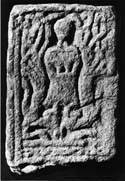
Object type: Part of cross-shaft
Measurements: H. (max.) 43.2 cm (17 in); W. 28 cm (11 in); D. 21.5 cm (8.5 in)
Stone type: Coarse-grained, massive yellow sandstone
Plate numbers in printed volume: Pl. 220.1250-1253
Corpus volume reference: Vol 1 p. 226-227
(There may be more views or larger images available for this item. Click on the thumbnail image to view.)
B (narrow): The remains of two panels of interlace enclosed by a double-grooved moulding. (i) Closed circuit turned pattern D with added diagonal. (ii) Only the terminals of an interlace survive.
C (broad): Apparently originally enclosed in a double moulding formed by grooving a wide flat-band, and is divided into three panels by crude cable mouldings. It is now very worn. (i) A `centaur' faces left and holds a round-headed staff in its right hand. The tail which terminates in a three-element leaf is knotted and joins with the creature's hair or halo. Between the crouched back legs and the front is a single circular space filler. (ii) A complete panel of interlace, three registers of simple pattern E set horizontally. The panel is framed by a double-grooved moulding. (iii) Possibly the remains of interlace.
D (narrow): Chiselled away.
This cross has been convincingly linked with Ovingham (no. 1), which also has the figure with a book (a saint?) standing under a tangled arch (Hastings and Romans 1946, 182; see Ovingham entry for discussion of the iconography). Other features such as the `centaur' and the horizontal panels of pattern E link it with the Aycliffe group (Adcock 1974, 349). However, the centaur on Aycliffe 2 has clearly evolved some way from the Tynemouth type. The centaur appears elsewhere on ninth-century carvings in Britain where it possibly symbolizes the dual nature of Christ. Here, the circle between its feet could also symbolize the Host. This stone at Tynemouth seems to reflect a copying of earlier iconographic types perhaps derived from Norham (Introduction, p. 28).
