Select a site alphabetically from the choices shown in the box below. Alternatively, browse sculptural examples using the Forward/Back buttons.
Chapters for this volume, along with copies of original in-text images, are available here.


Object type: Part of cross-shaft or architectural feature
Measurements: H. 24.1 cm (9.5 in); W. 43 cm (17 in); D. 12.2 cm (4.75 in)
Stone type: Coarse-grained, massive, micaceous yellow sandstone
Plate numbers in printed volume: Pl. 226.1266-1269
Corpus volume reference: Vol 1 p. 227-228
(There may be more views or larger images available for this item. Click on the thumbnail image to view.)
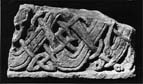
A (broad): The condition of the carved face is very unworn, but it has a covering of plaster in places, perhaps the backing for paint. There is a flat-band moulding on the lower edge. The face shows two, or possibly three ribbon animals, with double-outlined bodies. They have legs, ears, and tails enmeshed. The composition can be worked out in relation to two other panels on crosses: Durham (no. 1) and Aycliffe (no. 1). The animals' heads, one of which is top left, the other bottom right, have ear extensions, twisted lips and Ientoid eyes. The double outline of the bodies runs from behind the heads to terminate in a V on the back legs. The latter (only one of which is shown for each beast) are hardly less wide than the bodies. The one foot which survives terminates in well shaped toes.
No front legs survive, but by analogy with other carvings, it might have been raised below the throat of the beast. Each beast grips the back leg of the other in its jaws, while their thinner tails and ear extensions pass over and under the bodies forming a diamond-shaped twist under their back legs and a Stafford Knot below their backs.
B and D (narrow): Broken away.
C (broad): Roughly dressed and possibly recut, since the lower part is covered with plaster, like the front, and the upper is retooled to a smooth lower plane.
E (top): Roughly split.
F (bottom): Smoothly dressed, probably in its original form.
The smoothly dressed lower surface suggests that this piece is more likely to be an architectural fragment than part of a cross. The ultimate origin of this type of interlaced ribbon animal is to be found in Insular manuscript art, of the type of the Lindisfarne Gospels, fols. 27r, 139r, or the MacRegol Gospels [1]. It may well be, however, that the animal composition was translated to the Tynemouth, Durham (no. 1) and Aycliffe (no. 1) stones from an earlier cross rather than from a manuscript (see Durham 1; Introduction p. 32). On Lindisfarne 1 a similar animal is linked with another in a lyre-shaped composition (Cramp 1966, 121-2, pl. 3B). The Lindisfarne animal has a squared-off muzzle like the Lindisfarne Gospel beasts, but otherwise it is very like the example on Aycliffe 2, even to the shape of the one wide back leg with its double outline ending in a V-shaped terminal. The Lindisfarne beast has an ear and tail lappet and one other of similar size which could be a front leg. By the time the Aycliffe (no. 1) and Durham beasts were carved, all the extremities were reduced to the same narrow scale, possibly under the influence of the Jellinge beasts in Viking-age art. The Tynemouth piece stands midway in the tradition in that it keeps the more organic body and back leg, but its S-shaped composition and twisted lip are paralleled in Viking art. Tynemouth has clear links with Lindisfarne in the interlace patterns on other fragments, but its links with Durham are even stronger.
It seems sensible therefore to see this piece as tenth century in date, and to see the pattern as deriving from earlier Lindisfarne models which could have been found either on the Monk's Stone at Tynemouth, or on one of the Durham crosses.
