Select a site alphabetically from the choices shown in the box below. Alternatively, browse sculptural examples using the Forward/Back buttons.
Chapters for this volume, along with copies of original in-text images, are available here.


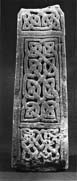
Object type: Neck and upper part of cross-shaft
Measurements: H. (max.) 89 cm (35 in); W. 29.3 > 23.5 cm (11.6 > 9.25 in); D. 17 > 13.5 cm (6.7 > 5.3 in)
Stone type: Medium-grained, massive yellow sandstone
Plate numbers in printed volume: Pls. 148,776-777; 149.782-783
Corpus volume reference: Vol 1 p. 146
(There may be more views or larger images available for this item. Click on the thumbnail image to view.)
The shaft is edged by wide grooved mouldings and fine inner roll mouldings.
A (broad): (i) A closed circuit version of a terminal half-register of pattern C with outside strands, from which two strands pass into the cross-arms. (ii) A complete panel surrounded on three sides by an inner roll moulding and at the base by a wide grooved moulding. These enclose four registers of complete pattern A with cross-jointed terminals. The three upper registers are turned. (iii) Part of a split plait.
B (narrow): At the top the shaft is plain and chamfered inwards to form the head. Three interlace panels below. (i) A small square panel with a grooved moulding at the base enclosing a knot formed from two closed circuit loops. (ii) A complete panel of five registers of simple pattern E with included terminal at the top and irregular terminal below. (iii) A fine horizontal roll moulding forms the bar terminal for an incomplete panel of three free rings with long diagonals (G.I., fig. 26, civ).
C (broad): Three very worn panels. (i) A bar terminal terminating what looks like turned pattern C or D. (ii) Two whole and two half registers of pattern C with outside strands. (iii) Almost obliterated, shallow key pattern (Allen 1903, no. 959).
D (narrow): The top is plain and chamfered inwards to form the neck. Below are two panels. (i) A small complete panel of almost obliterated straight line pattern, too worn to determine the type. (ii) An incomplete panel of broken plain plait in which six strands coalesce into three, then branch to produce six.
This shaft is competently and confidently carved, showing a good ability to adapt the ornament to the frames. Its plait types appear to localize it in the southern part of co. Durham. The distinctive branching strands are less competently carved at Durham (no. 2) and Chester-le-Street (no. 11), but often this is a distinctively Scandinavian interlace method. The split plait is also found at Chester-le-Street (no. 1), Jarrow (no. 4), Durham (nos. I and 11), Woodhorn (no. 1) and Aycliffe (no. 5). The pattern C with outside strands is identical with Durham 1, while the panel with free rings is paralleled at Aycliffe (no. 7). The small panel of key pattern again is a Lindisfarne feature found at Chester-le-Street (no. 5). One must therefore conclude that this cross was the product of a south Durham carver with strong Chester-le-Street/Durham connections. If it were to be assigned to a `Dale' centre, it would best fit Aycliffe.
