Select a site alphabetically from the choices shown in the box below. Alternatively, browse sculptural examples using the Forward/Back buttons.
Chapters for this volume, along with copies of original in-text images, are available here.


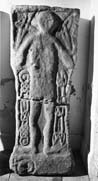
Object type: Grave-slab cut from Roman altar
Measurements: L. 132 cm (52 in); W. (at base) 51 > 49 cm (20 > 19.3 in); D. 19 cm (7.5 in)
Stone type: Medium-grained, massive yellow sandstone
Plate numbers in printed volume: Pls. 227.1281, 228.1286
Corpus volume reference: Vol 1 p. 229-230
(There may be more views or larger images available for this item. Click on the thumbnail image to view.)
The slab appears to have been split from a large Roman altar, of which part of the cable moulding survives on the vertical edges, and a moulding too worn to be decipherable across the top.
A (top): A large frontal figure extends from the top moulding to the bottom plinth. It has short arms outstretched with prominent raised thumbs on the hands. Its feet are out-turned. The head is wedge-shaped and has very prominent ears; traces of what are possibly eyes and a nose survive. The figure is so worn that it is difficult to make out details. It does seem, however, to be draped across the shoulders and to be wearing a short belted tunic. On either side of the head are two lop-sided interlinked loops with exaggeratedly pointed terminals. On either side of the body are two panels of interlace which are cut along the outlines of the body and legs. On the left the interlace is in three registers joined by long glides and terminating in circular loops each enclosing a pellet. The top and bottom registers seem to be a simple and closed circuit pattern F, the centre register a free ring. On the right the central element or register is a free ring, joined by long glides to the terminations which are in the form of split plaits. At the base a circular feature belongs to the capping ornament of the Roman altar.
B: Chamfered plinth (Roman).
C: Unworked.
D: Chamfered plinth (Roman).
This very inept carving, on which the figure is badly spaced and the interlace degenerate, is difficult to date. The figure may possibly be meant to be a crucified Christ, which the exigencies of the shape of the slab prevent from having its arms fully extended. The only hint of the Crucifixion pose is the upraised thumb. However, it could equally be a Christus Victor, or a secular figure. The units of pattern F and split plaits joined by glides are reminiscent of the Woodhorn cross-head. It seems that this is late and provincial carving copying patterns which were current in the area in the late tenth to early eleventh century.
