Select a site alphabetically from the choices shown in the box below. Alternatively, browse sculptural examples using the Forward/Back buttons.
Chapters for this volume, along with copies of original in-text images, are available here.


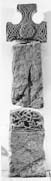
Object type: Incomplete cross-shaft in two fragments, and incomplete cross-head
Measurements:
(head): H. 44 cm (17.3 in); W. 51 cm (20.1 in); D. 14 cm(5.5 in) b
(upper part of shaft): H. 82 cm (32.5 in); W. 42 > 37 cm (16.5 > 14.5 in); D. 13 cm (5.1 in)
c (lower part of shaft): H. 86.5 cm (34 in)
Stone type: Medium-grained, irregularly bedded, yellow sandstone
Plate numbers in printed volume: Pls. 230.1302-1304, 231.1305-1311, 232.1312-1313
Corpus volume reference: Vol 1 p. 231-232
(There may be more views or larger images available for this item. Click on the thumbnail image to view.)
a (head):
Type A10, surrounded on the two broad faces by a roll moulding.
A (broad): There is a flat central roundel cleverly composed of a central motif of two intersecting loops which spin out into intersecting circles of interlaced strands. The upper arm has a split plait motif, in which the strands are bent into a V shape between the four end knots and the diagonalling strand becomes an edge strand. On the right arm is a ring-knot of two concentric rings crossed diagonally by two closed circuit loops. On the left arm is pattern E with outside strands, a form of ring-knot.
B (narrow): Uncarved.
C (broad): A central roundel of interlace very similar to face A. In the upper arm is an irregular filling of interlace terminating in two strands which form a single element of pattern E. On the right arm is an irregular ring-knot of one register of pattern C with outside strands. On the left arm are four elements of pattern A with cross-joined terminals, distorted to fit the space.
D (narrow): On the edge of the horizontal arm are two intertwined creatures, set in roll edge mouldings and with a flat-band at the top. Their composition is difficult to make out. Their bodies are confronted with front legs crossed and back legs crouched. Their heads cross so that the heads face in opposite directions. They have canine heads with pointed ears. The figure on the right has a tongue extension, which disappears behind its neck. The creature on the left has a tail extension which seems to join its ear.
b-c (shaft):
A (broad): The upper portion of the shaft has been chipped back or weathered away. At the base surrounded by a fine roll moulding are a pair of affronted griffins. Their heads are bent back over their bodies. The back leg with its three-toed foot extends stiffly over the body of the other. Their front legs appear to form a joining angular loop. Plume extensions cross over and under their bodies and cross again in the centre, ending with an inturned curl.
B (narrow): Mostly taken up by a pattern of interlace which must have been thirteen registers of simple pattern E, surrounded by a fine roll moulding. At the base the beginning of what seems to be an eight-cord interlace and part of a panel of ribbon animals.
C (broad): Split away.
D (narrow): (i) Possibly a panel of plant-scroll with very open medallions and twisted stems terminating in small plain triangular leaves. (ii) Part of a panel of ribbon animals. (iii) Possibly an eight-cord plait in a fine roll moulding. The terminal has a surrounded pattern F element and included U-bends.
This cross is carved in a very distinctive technique, very deeply cut with fine stranded interlace. However, the patterns, particularly of the animals, are weak and wavering. There is a clear link with the motifs which can be plausibly associated with the workshops of the Durham community: at Durham, Aycliffe, Hart, Tynemouth, Ovingham and Carham. Adcock (1974, 353-4) compares the interlace types with these centres and makes the interesting observation that an association of pattern E and pattern c is also found in the Lindisfarne Gospels, fol. 2v and 94v. In addition the animal types may have been derived from manuscript types, grotesque though they are: for example, the paired beasts on the side of the cross-arm are like the Psalter BL Cotton Vespasian A.1., fol. 30v. Paired and confronted animals are found in sculpture at Lindisfarne (no. 2) and possibly Hexham (no. 5). The paired griffins on face A of the Woodhorn shaft are paralleled in a stronger and more confident form on Aycliffe 1, Ai. The ribbon-like bodies of these creatures with their strange three-toed feet may also be compared with Chester-le-Street. In all aspects this piece seems to be related to work of the Chester-le-Street/Durham community.
