Select a site alphabetically from the choices shown in the box below. Alternatively, browse sculptural examples using the Forward/Back buttons.
Chapters for this volume, along with copies of original in-text images, are available here.


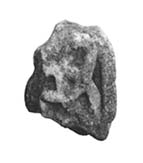
Object type: Cross-head fragment
Measurements:
(Derived from catalogue entry and scaled drawing published 1976) H. 10.6 cm (4.2 cm); W. 7.6 cm (3 in); D. 4.8 cm (1.9 in);
Estimated original diameter [of complete cross-head] c. 26 cm (10.2 in), with wheel-holes c. 6 cm (2.4 in) in diameter
Stone type: Coarse cream oolite with fossil inclusions' (Rahtz 1976, 26)
Plate numbers in printed volume: Ills. 123-8; Fig. 27J
Corpus volume reference: Vol 10 p. 161-2
(There may be more views or larger images available for this item. Click on the thumbnail image to view.)
Found in archaeological excavation during 1972 in a pit (SEF35) just east of the apse (Rahtz 1976, 11, 26, 55, ST3).
'Fr[agment] of wheel-headed cross, seed-pod design on one side, two-strand [triquetra] interlace on the other; traces of red paint on pods side, on edges of holes, and on outer edge either side of central band; white paint in recessed areas; no paint visible on interlace side; outer edge has smooth slightly shiny band in centre; this is in places light brown and grey in colour. Professor Cramp says this is a "priming" material to facilitate subsequent colouring; there is possibly similar material in the recesses on the pods side (where there is no white — but not clearly underlying it); there is none under the red paint. ... [Wheel-] holes not symmetrical — different distances from edges; room for four holes as shown in [published] reconstruction. Professor Cramp thinks it has never been exposed to external erosion ...' (taken from the published catalogue entry: Rahtz 1976, 26, ST3).
Richard Bailey was not convinced by 'the circle-head reconstruction ... preferring a fan-shaped form analogous to cross-head[s] from Bath' (Bailey 2005, 2, 25 n. 8; cf. Cramp 2006, ills. 173–9). Both forms are possible.
The theft of this small fragment is very unfortunate, particularly in view of the survival of so much paint. As a result, the published record, including Rosemary Cramp's valuable comments, assumes an even greater importance. The seed-pod design is very similar to a late eight-/early ninth-century fragment of finial or cross-head from Berkeley (Berkeley Castle 1, Ill. 15). Analysis of the surface preparation and surviving paint on the high-level painted panel (Deerhurst St Mary 7), on the Virgin and Child carving (Deerhurst St Mary 5), and on the chancel-arch animal heads (Deerhurst St Mary 18, 19) has shown that the surface of the stone was in each case carefully smoothed, perhaps even burnished, and that red paint (iron oxide red) was then applied directly onto the stone without a priming ground (Bagshaw et al. 2006, 69; Howe 2006a, 18–21, 59; Gem et al. 2008, 142–4; see Chapter X above). On the animal head to the north of the chancel arch (Deerhurst St Mary 18, colour frontispiece, Pl. 1), iron oxide yellow was used as a wash over the red oxide lines, and it is possible that the light brown colouring seen in places on the smoothed central band of the cross-head may also be this yellow pigment. A carbonate white ground overlaid with yellow oxide was also used to create areas of emphasis on no. 18 (see p. 183), and this is probably similar to the white paint found in the recessed areas (on the seed pod side?) of the cross-head.
Butler suggested that the cross-head was 'probably a headstone and may be evidence for a monastic cemetery' (Rahtz 1976, 26). Cramp, however, felt that the fragment had never been exposed to external erosion (ibid.), and the survival of so much polychrome would tend to support her view. The fact that colour only survived on one face and on the edge of the cross-head may have been due to differential weathering whilst in the soil, but it may also indicate that the cross-head was more highly decorated on one side than the other, as seems originally to have been the case with the similar Berkeley fragment (Berkeley Castle 1). The un-weathered nature of this cross-head, together with the similarity of colours used on much of the carving that is now associated with the Period IV development of the church, leads the present author to suggest that this piece should be seen as part of the sculptural enhancement of the interior of the Period IV church. It could have come from a small, freestanding cross, or a cross-finial from a reliquary or tomb, perhaps the tomb of the benefactor Æthelric or his father Æthelmund (see fuller discussion under Deerhurst St Mary 13).
Deerhurst was an important minster church, first mentioned in 804 (for further discussion of Deerhurst in the early ninth century, see Deerhurst St Mary 13 below, p. 180). According to his late eleventh-century Life, St Ælfheah (Alphege) began his career at Deerhurst; Ælfheah, as archbishop of Canterbury, was martyred at Greenwich in 1012 (Wormald 1993, 7–9). Ælfheah's sojourn at Deerhurst is likely to have been in the 960s or 970s. It is possible, but far from certain, that Deerhurst was briefly a Benedictine community at around this time (Wormald 1993, 8–9; Lapidge 2009, 112–14). Towards the end of the reign of Edward the Confessor (1042–66), the church at Deerhurst together with its estates was given to the monastery of St Denis, and the church became an alien priory (Wormald 1993, 18). The extent of Deerhurst's minster parochia has been discussed and mapped by Bassett (1998).
