Select a site alphabetically from the choices shown in the box below. Alternatively, browse sculptural examples using the Forward/Back buttons.
Chapters for this volume, along with copies of original in-text images, are available here.


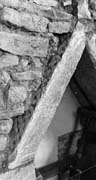
Object type: Grave-cover
Measurements: L. 94 cm (37 in); W. 45 > 44 cm (17.7 > 17.3 in); D. 15 > 14 cm (5.9 > 5.5 in)
Stone type: Moderate orange (5YR 8/3) grain supported shelly, spar cemented oolite with many hollow grains which range in size from 0.2 to 0.8 mm. Cleeve Cloud Member, Birdlip Limestone Formation, Inferior Oolite Group, Middle Jurassic.
Plate numbers in printed volume: Ills. 129-31
Corpus volume reference: Vol 10 p. 162-3
(There may be more views or larger images available for this item. Click on the thumbnail image to view.)
Discovered during plaster-stripping and structural study in 1974 (Rahtz et al. 1997, 52).
Decorated grave-cover, reused as one of a pair of stones forming the triangular-head of opening OP20 (Rahtz et al. 1997, 52, figs. 33–6). A narrow strip of the carved surface was visible on the north side of the wall when the plaster was removed. Now only about 3.5 cm of the carving can be seen, but the photograph used in the present volume was taken at the time of the discovery and shows a little more. The visible area is carved with interlace decoration in deep relief. The strands are about 2.5 cm (1 in) wide near the lower end of the stone, narrowing to 1.9 cm (0.7 in) near the top, and are tightly woven into what appear to be turned patterns with added outer strands and diagonals (see Ills. 130, 131 for a drawing of the visible area of interlace and a proposed reconstruction).
If the reconstruction of the design suggested above is correct, then the full width of the turned patterns would only have been about 17 cm (6.7 in) at the lower end of the stone narrowing to about 15 cm (5.9 in), suggesting that the pattern acts as part of a border (perhaps around a low-relief cross), or that the stone is covered with parallel zones of carving similar to the mid tenth- to late eleventh-century Lindsey group of grave-covers from Lincolnshire (Everson and Stocker 1999, 50–7, figs. 14–15). Other solutions would also be possible, but the fact that the carving appears to narrow gradually from one end of the stone to the other, is an indication that the stone itself tapered like at least two of the grave-covers from Gloucester (Gloucester St Oswald 5 and 9). The doorway, in the head of which this stone is reused, probably belongs to late ninth- or tenth-century modifications to the church. This would suggest a date for the grave-cover in the ninth century or earlier.[1]
