Select a site alphabetically from the choices shown in the box below. Alternatively, browse sculptural examples using the Forward/Back buttons.
Chapters for this volume, along with copies of original in-text images, are available here.


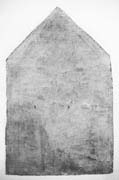
Object type: Panel
Measurements: H. 138 cm (54.2 in); W. 87 cm (34.2 in); D. unknown, stone projects 1 cm (0.4 in) from face of wall plaster
Stone type: Oolitic limestone (oosparite)
Plate numbers in printed volume: Ill. 151; Fig. 32F
Corpus volume reference: Vol 10 p. 173-4
(There may be more views or larger images available for this item. Click on the thumbnail image to view.)
Carved stone panel with triangular top. The remains of a painted figure survive on this panel (Bagshaw et al. 2006). The stone carries a variety of marks and scratches, including broad, shallow axe marks, up to 8 cm (3.1 in) in length. These are not aligned in any consistent direction and have an abraded appearance, as does much of the surface of the panel, suggesting that it was rubbed with an abrasive, or weathered, after the axe marks were made but prior to being painted. This type of shallow axe mark is visible on some of the other Anglo-Saxon worked stones and sculpture elsewhere in the church.
The figure is painted in dark red line on to the carefully prepared surface of the stone. Examination of the stone with a x10 hand-lens showed that there did not seem to be a priming gesso layer on the stone. A significant amount of the figure has been lost, perhaps as a result of a deliberate attempt to remove the painted image or when the limewash, that once covered the panel, was removed, probably during the restoration of the church in 1861–2.
The painted figure is likely to have served as the preparatory drawing for a polychrome image, but no trace of any other pigment has yet been detected. The painting is of a standing figure within an architectural frame which consists of a triangular-headed arch supported by piers with stepped capitals and bases (see Fig. 32F, p. 93). Setting-out lines, inscribed in the stone, define the sides of the pillars and are also visible running up across the capital from the top of the pier to the figure's right, and down across the base from the bottom of the pier to the left of the figure. Two parallel painted lines, one of which cuts across the left side of the figure's halo, are later than the painting and probably indicate the position of a wall batten or the frame of a panel of a later date that at least partially obscured the painted figure. The most obvious feature of the figure is the halo, painted in a bold, wide curve and resting upon the shoulders. The figure's left shoulder is more complete than the right, but both are clear. The face is delicate, and it required several sessions with different lighting and very close inspection fully to realise that much of the right eye survives, together with the nose, the nostrils and most of the upper lip. The hair on the left side of the face seems to cover the ear and could be braided. The crown of the head survives, as does part of the neck on the right side. The figure's right cheek is rounded, but none of the chin could be discerned.
The figure is clothed in a long tunic, and an over-garment which is gathered in above the waist. The folds of the over-garment are drawn in fine, flowing lines, with delicate detailing and a lightness of touch such as is often found in the line work of manuscript illustrations. The draperies 'fly out' on either side of the figure in the style found in many manuscript illustrations of the tenth century. The figure holds a rectangular object, presumably a book, in his draped left hand. Little of the right arm and none of the right hand survives, but the remains of the folds of the sleeve indicate that the arm was raised, perhaps in blessing. The lower part of the figure is more fragmentary. To the left of the figure, about halfway down, there is a narrow, horizontal rectangular painted shape with a rather broken outline. This may be the remains of a table or stand.
The triangular head of the painted panel might indicate that this is a reused Roman gravestone. However, the stone could also have been deliberately carved into this shape, for the top of the stone is used to emphasise the triangular 'arch' painted above the figure, and this in turn is similar to a number of the architectural details still visible in the church. These details include the top of the surviving bay of the demolished polygonal apse; the triangular-headed doorway between the central space (the present sanctuary) and the principal north porticus; the three triangular squint windows at first floor level at the west end of the nave, and the famous double triangular-headed opening at high level in the west wall of the nave (Deerhurst St Mary 23, Ills. 215–17). Some of these features belong to Period IV (late eighth to early ninth century) in the development of the church, while the decorated double-window and possibly the triangular-headed doorway are argued to belong to Period V (later ninth century or later) (Rahtz et al. 1997, 175–9) . The stepped imposts of the painting can also be paralleled elsewhere in the church: the feature occurs on the double triangular-headed opening mentioned above and on the carving of the Virgin and Child (Deerhurst St Mary 5, Ill. 147) at the west end.
The image itself, of a standing, nimbed figure, holding a book in his draped or shrouded hand, has been described in detail elsewhere and, on art-historical grounds (in particular the light, billowing clothing) a date in the mid to late tenth century has been proposed for this painting (Bagshaw et al. 2006, 74–83, 102, figs. 2–5). It is assumed that the specially prepared panel is of similar date.
