Select a site alphabetically from the choices shown in the box below. Alternatively, browse sculptural examples using the Forward/Back buttons.
Chapters for this volume, along with copies of original in-text images, are available here.


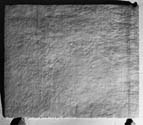
Object type: Panel
Measurements: H. 100 cm (39.3 in); W. 119 cm (46.8 in); D. unknown, but at the top the stone projects c. 5 cm (2 in) from the face of the wall and at the bottom it projects between 1 and 1.5 cm (0.4 and 0.6 in).
Stone type: Not accessible for examination, but certainly an oolite and probably Cleeve Cloud Member, Birdlip Limestone Formation, Inferior Oolite Group, Middle Jurassic.
Plate numbers in printed volume: Ill. 150
Corpus volume reference: Vol 10 p. 172-3
(There may be more views or larger images available for this item. Click on the thumbnail image to view.)
Rectangular panel, possibly for a painted inscription. Most of the face of the stone is covered with shallow axe-marks, rubbed or burnished to give a fairly smooth surface. There is a slightly raised area in the lower centre of the panel. The axe-marks on the upper right edge in this area are more obvious, about 10 cm (3.9 in) long, and they run in a diagonal line from upper left to lower right. This whole area looks as though something has been trimmed flat, and the more clearly defined axe-marks might indicate a triangle shape with its apex to the right. However, in raking light the area appears more circular in overall shape, with a semi-circular extension at the top, or perhaps like a lozenge with rather rounded sides. The centre of this area is more highly burnished with fewer surviving axe-marks. The top and bottom edges of the panel have been dressed-back slightly in bands c. 15 cm (5.9 in) wide.
The slightly raised area on the face of this panel could be geological in origin. Equally, if the more obvious axe-marks do betray a possibly triangular shape, this might indicate that the panel is a reused Roman tombstone originally bearing a triangular pediment. However, neither suggestion fully explains the differential treatment of the surface of the stone. The evidence from other Anglo-Saxon sculpture in the church indicates that the stone was smoothed to take paint. It has been suggested that this panel could have carried a painted inscription (e.g. Taylor and Taylor 1965, i, 198), but the slightly off-centre area that is more highly burnished might indicate that, as well as an inscription, the panel carried a painted figure (if the area is lozenge-shaped) or the painted bust of a figure (if the area is roughly circular with the semi-circular projection from the top).
There are two other panels at the same level at the east end of the church (Deerhurst St Mary 7 and 8, Ills. 151–2). These panels are smaller with triangular heads, but the treatment of the surface on each is very similar to the western panel, and on the northern panel a mid to late tenth-century painted figure has been found (see below). The figure is nimbed and stands below a triangular-headed 'arch' with stepped imposts similar to those of the double opening (Bagshaw et al. 2006). There is little doubt that this figure was once matched by a figure on the southern panel. It is suggested that all three panels may be of similar date.
