Select a site alphabetically from the choices shown in the box below. Alternatively, browse sculptural examples using the Forward/Back buttons.
Chapters for this volume, along with copies of original in-text images, are available here.


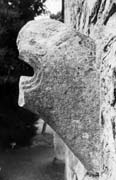
Object type: Incomplete prokrossos
Measurements: H. 50 cm (19.7 in) at wall; 36 cm (14.1 in) at broken muzzle; W. 32 cm (12.6 in) across lower neck at wall; 27 cm (10.6 in) across broken muzzle; D. 29 cm (11.4 in) from wall to broken muzzle
Stone type: Very pale orange (10YR 8/2) grain supported, spar cemented oolite with solid ooliths ranging in size from 0.2 to 0.6 mm. Cleeve Cloud Member, Birdlip Limestone Formation, Inferior Oolite Group, Middle Jurassic.
Plate numbers in printed volume: Ills. 153-6, 788; fig. 26PA
Corpus volume reference: Vol 10 p. 175
(There may be more views or larger images available for this item. Click on the thumbnail image to view.)
In situ. Noted in present position by Haigh (1846, 13) and Butterworth (1862, 93) and visible in a photograph taken before the major restoration of 1861–2 (Knowles 1927, pl. XIII (fig.1)).
Animal-head prokrossos above the west door. The neck of this creature is rounded in cross section, similar to the cut-back remains of the prokrossos above the south door (Deerhurst St Mary 15, Ills. 188–90) but quite unlike the angular shape of the high level western prokrossos (no. 10, Ills. 159–64). The remains of the head are also rounded, while the forehead, eyes, muzzle and lower jaw are missing. The double-outlined remains of the mouth show that the beast was open-jawed. The faint remains of vertical divisions on the inner moulding around the mouth suggest that this was carved to represent teeth. Above the mouth, on the north side of the head, is a double-line incised 'moustache' that terminates in a tight curl. A small fragment of a similar curling terminal survives on the south side. Above the 'moustache' on the northern face is a tightening spiral carved in relief. This is probably the terminal of a brow-ridge similar to other beast heads from the site.
This (presumably) snarling animal stands guard over the main entrance to the church, and is set centrally above the remains of a round-headed doorway outlined by a square-section hood-moulding (Ill. 157). The surviving facial features of this great beast are similar to those of several of the other Deerhurst animal heads. The damage to the prokrossos may have been sustained when the spire of the church was blown down in 1666 (Fendley 2005, 400).
(See Deerhurst St Mary 13, p. 177, for a general discussion of the animal-head carvings and Chapter IX, p. 110, for a discussion of the archaeological and structural context for the Deerhurst sculpture.)
