Select a site alphabetically from the choices shown in the box below. Alternatively, browse sculptural examples using the Forward/Back buttons.
Chapters for this volume, along with copies of original in-text images, are available here.


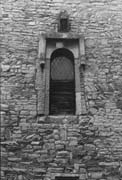
Object type: Incomplete prokrossos
Measurements: H. 49.5 cm (19.5 in) from top of brow ridge to base of neck at wall; 23.5 cm (9.2 in) at muzzle; W. 27.4 cm (10.8 in) at base of neck; 22.7 cm (8.92 in) at brow ridge; 19 cm (7.5 in) at muzzle; D. 39 cm (15.3 in) from wall to muzzle
Stone type: Inaccessible but almost certainly oolite and probably Cleeve Cloud Member, Birdlip Limestone Formation, Inferior Oolite Group, Middle Jurassic.
Plate numbers in printed volume: Ills. 157-64, 788; Fig. 26PB
Corpus volume reference: Vol 10 p. 175-6
(There may be more views or larger images available for this item. Click on the thumbnail image to view.)
In situ. Noted in present position by Haigh (1846, 13) and Butterworth (1862, 93) and visible in a photograph taken before the major restoration of 1861–2 (Knowles 1927, pl. XIII (fig.1)).
Animal-head prokrossos. This creature is much more angular that the lower example (Deerhurst St Mary 9). The top of the beast's head rises in an almost straight line from the square muzzle to a sharply defined brow-ridge before falling away through a shallow curve to the wall. Below the muzzle there is an abrupt angle between the straight-sided jaw and the equally straight-sided neck. A narrow band (c. 3 cm wide with a recessed centre between narrow bordering ridges) runs at an angle from the brow ridge down across the neck towards the wall. This could be a strap similar to the muzzle strapping on a prokrossos from Gloucester (Gloucester Tolsey 1, Ills. 377–8), but it could also be a geological feature. The end of the muzzle has broken away on the southern side, leaving a vertical scar. The jaws may have originally been even longer than the surviving stone suggests. There is no detailing of facial features.
This prokrossos is significantly different to the other Deerhurst beasts. It is also set centrally above a very distinctive, straight-topped and straight-sided hood-moulding which follows the shape of the lintel rather than the semi-circular head of the high-level doorway (Ill. 157). However, the doorway is associated with a second-floor chamber in the tower and a gallery around the tower that Hare (2009, 55–6) has shown belong to the same structural phase as the other Deerhurst animal heads (Period IV in the development of the building as originally defined by Rahtz et al. 1997). There is no indication that this prokrossos and its associated animal-head label stops (nos. 11–12) are later inserts or adaptations to the Period IV fabric. Furthermore, despite the differences in the style of carving when compared to the more fully decorated animal heads (nos. 13, 14, 16–18), there are also similarities to the more simplified, blocked-out style employed on the southern animal head on the chancel arch (Deerhurst St Mary 19, Ills. 206–10) and on the Virgin and Child (no. 5, Ill. 147). Recent study supports the opinion that these carvings were originally as highly decorated as any of the other Deerhurst carvings, but that all the surface detailing was added in paint (Gem et al. 2008) Therefore, it is suggested that this prokrossos and its accompanying label-stop beast heads (nos. 11 and 12) belong to the same programme of building and carving as the other animal heads and much of the rest of the sculpture, and that the missing details would have been added in paint.
