Select a site alphabetically from the choices shown in the box below. Alternatively, browse sculptural examples using the Forward/Back buttons.
Chapters for this volume, along with copies of original in-text images, are available here.


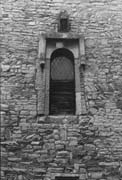
Object type: Animal-head label stop
Measurements: H. 29.8 cm (11.7 in) at wall; 27.5 cm (10.8 in) at face; W. 12.3 cm (4.8 in); D. 18 cm (7 in)
Stone type: Probably oolite but too inaccessible to examine closely. Probably Cleeve Cloud Member, Birdlip Limestone Formation, Inferior Oolite Group, Middle Jurassic.
Plate numbers in printed volume: Ills. 157-8, 165-9, 788; Fig. 26H
Corpus volume reference: Vol 10 p. 176-7
(There may be more views or larger images available for this item. Click on the thumbnail image to view.)
The animal head is slab-sided with a straight-cut muzzle. The front of the face is lightly defined with a slightly rounded muzzle twisted a little to the north and rising through a low brow to the forehead. The top of the head is triangular in shape and the chamfered edge carries incised lines which are probably the remains of a fringe. This feature is clearer on the northern label stop of this pair (no. 12). The ears are not defined at all. Two very faint shapes in the middle of the crest that rises from behind the creature's head may be rudimentary versions of the lobed cresting that appears on some of the other Deerhurst animal heads.
This animal head, and its northern partner, are integral with the vertical side elements of the square hood-moulding that frames the lintel over the high-level western door. As with the prokrossos above the hood-moulding, both animal heads are much more angular than the other Deerhurst animal heads, with straight-cut, slab sides, undefined jaws and virtually no facial features. It has been suggested that this may be in part due to their high-level location, but they would have been at about head height in relation to anyone standing on the proposed gallery onto which the high-level doorway gave access (Hare 2009, 43–70). Not only are these two label stops different in overall shape, but the crowns of their heads are triangular and decorated with fringes of short curving hair. None of the other Deerhurst animals bear this feature. However, it seems clear that these high-level carvings are contemporary with the other animal-head carvings (see fuller discussion for Deerhurst St Mary 10) and the difference in style is, therefore, more likely to be due to a different carver than a difference in date.
