Select a site alphabetically from the choices shown in the box below. Alternatively, browse sculptural examples using the Forward/Back buttons.
Chapters for this volume, along with copies of original in-text images, are available here.


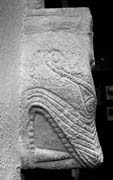
Object type: Animal-head label stop
Measurements: H. 25.5 cm (10 in); W. 8.8 cm (3.5 in) top of head; 11 cm (4.3 in) at brow below ears; 5.7 < 6 cm (2.2 < 2.4 in) at muzzle; D. 13.5 cm (5.3 in) at top of head; 14 cm (5.5 in) at muzzle.
Stone type:
Yellowish grey (5Y 8/1) shelly, sparry cemented oolite, variably grain and matrix supported. Ooliths mainly solid and range between 0.2 and 1 mm in size. Shell debris mainly between 2 and 4 mm in size but some up to 10 mm. Cleeve Cloud Member, Birdlip Limestone Formation, Inferior Oolite Group, Middle Jurassic.
One suggestion as to the original location of this animal head is that it terminated the northern end of the hood-moulding above the lower western doorway (see above). The geology of this section of hood-moulding is, in fact, very similar to the animal head and is therefore appended below.)
Hood-moulding stone type: Pale yellowish orange (10YR 8/6) slightly shelly, sparry matrix supported oolite. Some hollow ooliths which range in size between 0.2 to 0.8 mm. Shell debris up to 2 mm. Cleeve Cloud Member, Birdlip Limestone Formation, Inferior Oolite Group, Middle Jurassic.
Plate numbers in printed volume: Ills. 175-81; Fig. 26A
Corpus volume reference: Vol 10 p. 177-80
(There may be more views or larger images available for this item. Click on the thumbnail image to view.)
The contractor's ledger for the restoration of 1861–2 contains an entry under March 22 1862 which shows that a mason by the name of Daffurn fixed 'old heads under label of Tower doorway'; there is a similar entry in the parish accounts of the restoration, which shows that Daffurn spent two days on this job (Gloucestershire Archives, D843/1/1, p 294 and P112 CW 3/1). In 1890 Butterworth wrote of these beast-heads that 'this ornament..., as one who sanctioned the present arrangement, is not in its original position' (Butterworth 1890, 78); this observation should presumably be read in conjunction with the discovery during the restoration of 1861–2 of 'two well-carved ends of a label, being animals' heads' in the blocking of the triangular-headed doorway between the chancel and the east end of the north aisle (Butterworth 1862, 97).
It was long believed that these animal heads were discovered at the ends of the hood-mould of the external west doorway; this belief was based on a statement by Haigh (1846, 13) that the hood-mould had terminations 'which are carved, probably into grotesque heads, but they are so completely obscured by the plaster, that it is impossible to speak positively on this point'. The doorway was rebuilt in the first half of the fourteenth century, leaving only the hood-mould and other slight traces of the Anglo-Saxon doorway above it; as it survives, the masonry around the west doorway appears to allow no place for animal heads to have been removed in 1861–2. Haigh's remark is perhaps best considered as conjecture based on other openings at Deerhurst with hood-moulds. Nevertheless it is worth noting that alterations were made to the east end of the north aisle in the first half of the fourteenth century, and these could have included the blocking of the doorway in which the beast-heads were found. The animal heads could therefore have come from the west doorway, but have been removed from it at an earlier date than previously suggested. In favour of this hypothesis is the fact that the width of the animal heads corresponds closely to the mutilated remains of the raised section of the hood-mould; this can be measured as about 11.5 cm. However, this is by no means the only possibility, and other doorways should be considered as possible candidates (including the blocked doorway beneath the window in the north wall of the north aisle opposite the blocked doorway in which the animal heads were found); doubtless there were also other doorways, now completely lost.
This is perhaps the best known of all the Deerhurst animal heads. The incised decoration on its face is 0.1 to 0.2 cm deep, and is sharp and skilfully executed. The muzzle and forehead are covered with close-set, concentric incised grooves, while the eyes are surmounted by sweeping brows with tightly curving terminals. The eyes themselves are like water droplets (round at one end and pointed at the other), with large, perfectly circular pupils. The fangs (which are enormous in relation to the size of the head) are carved in detail, rounded on the sides and in the open-mouth lower face (face F). The rest of the creature's teeth are square and cut back 0.2 cm from surface of the jaws. The inside of the mouth is cut back a further 0.5 cm (0.2 in). The concentric grooves of the forehead are extended into ovals around the base of the ears, which are long and pointed with hollowed-out centres and in-turning, comma-like tips. Above the ears there is a wide crest or mane that is carried along the top (back) of the head to the wall line as two (south side) or three (north side) roll mouldings. Between the ears this crest or mane is decorated with a delicately carved trefoil consisting of a central round-topped element flanked by two with outward curling tips. On the north side of this animal head there is a small, sharply-defined, egg-shaped incised carving between the ear and the eyebrow terminal. There is a similar feature on the south side but it is much less clear due to weathering. Also on the north side the lowest level of the roll mouldings, that form the sides of the creature's crest or mane, is decorated with cording behind the ear. This does not appear on the south side. The remains of red paint (iron oxide red with probable haematite inclusions) survives in the mouth of this animal head (Howe 2006a, 36; Gem et al. 2008, 115–30).
Animal-head label stops are used widely in western England from the ninth to the twelfth centuries. In the area of western Mercia covered by this volume examples that are definitely or probably Anglo-Saxon occur in Gloucestershire at Deerhurst, South Cerney, and Gloucester (four excavated beast heads or fragments of beast heads: Gloucester St Oswald 18, 27–29). There are also examples from Worcestershire at Wyre Piddle and Ripple.
The carving on this animal head is very similar to the carved and painted decoration on five of the other Deerhurst animal heads, including the head to the north of the west door, and those on the chancel arch and the south doorway (nos. 14, 16–19). The surviving carved details on the prokrossos above the western door (no. 9) are also closely related in style. The features come from a long tradition used widely in Anglo-Saxon metalwork, stone carving and manuscript art from as early as the eighth century. Richard Bailey offers the beast at the top of the nasal on the Coppergate helmet from York as an example of an almost identical beast from the third quarter of the eighth century, and he also draws attention to the distinctive trefoil shape that appears between the ears of the Deerhurst head and on ninth-century strap-ends from Whitby (Bailey 2005, 5, 7). The Alfred Jewel found near Athelney in Somerset is a late ninth-century example (Webster 1991b, 282–3, ill. 260), while locally several of the features are found on a mid eighth-century copper-alloy key from Gloucester (Webster 1991a, 222–3, ill. 176). In manuscript art beast-heads proliferate but most are rounder with shorter snouts. A close parallel can be found in the two beasts at the head of a canon table (fol. 16r) in the St Petersburg [Leningrad] Gospels, possibly a product of Lindisfarne and dated to c. 800 (Henry 1974, 203, 214, 226, fig. 57). The continuing influence of the Hiberno-Saxon tradition in manuscript art on stone carving in the West Country is discussed by Rosemary Cramp in Volume VII of the Corpus (Cramp 2006, 42–8). This influence is equally clear in west Mercian carving as shown by an example — with a long snout, a mouth full of sharp teeth, and eyes that are drawn out into tightly curling brow ridges — from the Quoniam page (fol. 188r) of the Gospel of Luke in the Book of Kells, dated 790–830 (Henry 1974, 61, 216). In stone there are similar creatures from the West Country (Cramp 2006, 45, fig. 20), while in the west Mercian area examples can be found on a cross-shaft fragment from Coventry (Warwickshire) and the cross-head from Cropthorne and a cross-shaft from Tenbury Wells (both Worcestershire). A rather more peaceful creature, but still with a long, heavily-grooved snout can be found on a cross-shaft from Wroxeter (Shropshire). From Gloucestershire there is a heavily weathered, long-snouted creature at Abson, but some of the best examples come from Gloucester itself, on a small stone fragment from St Mary de Lode (St Mary de Lode 2) and on the 'Mercian' beasts from an early ninth-century cross-shaft from St Oswald's (St Oswald 3).
There is a general consensus that the Deerhurst animal heads belong to the ninth century. David Wilson has shown that parallels can be securely drawn with metalwork of the late eighth and ninth centuries (pers. comm. cited in Taylor 1978, 1057). Richard Gem has proposed a date in the middle years of the ninth century (Gem 1993, 53), and Richard Bailey has supported an earlier ninth-century date (Bailey 2005, 7). Rahtz et al. proposed that all the Deerhurst carving belonged to their Period V, which they dated with the support of an earlier suggestion from Richard Gem (Gem 1984, 242) and with radio-carbon evidence to the late ninth century (Rahtz et al. 1997, 179). However, recent structural analysis of the church by Steve Bagshaw (Bagshaw et al. 2006, 85–96) has shown that the polygonal apse and the south porticus, together with the lower part of the western porch, were built at the same time as the east wall of the nave in Period IV, and that the chancel arch, with its integral beast-head label stops, was also part of the Period IV church. Recent work by Michael Hare (2009, 55–6) has further refined the building sequence by showing that the porch up to and including the second-floor chapel with its high-level western door is of one build and bonded into the west end of the Period IV church. Period IV at Deerhurst was dated by the excavators on various grounds (including two more radio-carbon dates) to the late eighth or early ninth century (Rahtz et al. 1997, 174).
There is very little doubt that the six 'ground floor' animal heads (nos. 13–14, 16–19), so alike in many aspects of their carved and/or painted schemes of decoration, belong to the same phase of work, as does the prokrossos above the western door (no. 9). The high level prokrossos and animal heads on the western face of the porch (nos. 10–12) are treated in a more stylised manner, but this is very similar to the treatment of the southern beast head from the chancel arch (no. 19). Furthermore, there is no indication that they are inserted into what is almost certainly Period IV fabric, so they can be viewed as contemporary with the other animal heads. It is, therefore, suggested that the beast heads and prokrossoi, together with the Virgin and Child carving (no. 5) from the porch and the Archangel (no. 4) from the apse (both integral with walls now shown to belong to Period IV) should all be seen as part of the Period IV church and that they should be dated to the first half of the ninth century. The ornate, double-triangular headed opening (no. 23) at the same level is inserted into the Period IV fabric and probably belongs to the later ninth-century Period V. A date in the first half of the ninth century for the main 'sculptural phase' at Deerhurst would fit well with what Gem describes as 'a flourishing artistic tradition [in manuscript art, metalwork and carving in the midlands and southern England] in the late eighth century and the first half of the ninth century' (Gem 1984, 237–8).
A date in the first half of the ninth century would also indicate the possibility that the work of this period was connected with the recorded patronage of an important family in the area. In or around 804 Æthelric son of Æthelmund made testamentary provision for four estates to pass to Deerhurst following his death (Sawyer 1968, no. 1187). Æthelric, who had recently returned from a pilgrimage to Rome, made this bequest on condition that his body should be buried at Deerhurst; Æthelric's testament also implies that his father Æthelmund (probably the ealdorman killed in battle in 802) was already buried at Deerhurst. The provisions of Æthelric's testament were confirmed at a council in 824 (Sawyer 1968, no. 1433), by which time Æthelric was dead. The patronage of this important family seems likely to have benefited the minster community at Deerhurst to a substantial degree, and the Period IV church with its associated sculpture may well reflect this impetus (Wormald 1986, 152–7; Wormald 1993, 2–7; Gem 2008; Hare forthcoming a).
(See Chapter X for a detailed summary of the Deerhurst polychrome.)
