Select a site alphabetically from the choices shown in the box below. Alternatively, browse sculptural examples using the Forward/Back buttons.
Chapters for this volume, along with copies of original in-text images, are available here.


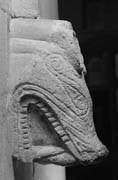
Object type: Animal-head label stop
Measurements: H. 23.7 cm (9.3 in); W. 9.5 cm (3.7 in) top of head; 12 cm (4.7 in) at brow below ears; 5.6 cm (2.2 in) at muzzle; D. 11 cm (4.3 in) at top of head; 15.5 cm (6 in) bottom of muzzle
Stone type:
Yellowish grey (5Y 8/1) shelly, spar cemented oolite, variably grain and matrix supported. Shell debris very common, more than in Deerhurst (St Mary) 13. Ooliths range in size between 0.2 and 0.8 mm and shell debris 8 to 20 mm. Inclusions and irregular seams of fine grained material may be repair cement. Cleeve Cloud Member, Birdlip Limestone Formation, Inferior Oolite Group, Middle Jurassic.
(As with no. 13 above, one suggestion as to the original location of this animal head is that it terminated the southern end of the hood-moulding above the lower western doorway (see above). The geology of this section of hood-moulding is, in fact, very similar to the animal head and is therefore appended below.)
Hood-moulding stone type: Pale orange (10YR 8/4) to pale yellowish orange (10YR 8/6) very shelly oolite, sparry matrix supported and with many hollow ooliths. Oolith size 0.4 to 1.0 mm. Shell debris up to 5 mm. Possible occasional grains of glauconite. Cleeve Cloud Member, Birdlip Limestone Formation, Inferior Oolite Group, Middle Jurassic.
Plate numbers in printed volume: Ills. 182-7; Fig. 26B
Corpus volume reference: Vol 10 p. 180-1
(There may be more views or larger images available for this item. Click on the thumbnail image to view.)
The muzzle of this animal is much more tipped up and forward than on the southern animal head, no. 13. This may be because the head has been badly damaged at the top (back part of stone), and was, therefore, more difficult to set accurately in the wall in 1862. The incised decoration is very similar to the southern animal, although much more degraded by weathering. The muzzle is covered with close-set concentric grooves, but the forehead is not. The eye on the south side of this creature's head is similar to no. 13, shaped like a water droplet with a circular pupil and surmounted by a sweeping brow that ends in a tightly curving terminal. The eye on the north side is similar but the terminal of the brow has been lost in the damaged area on the side of the head. The fangs are huge and deeply carved, rounded in side view and in open mouth on lower face (face F). The teeth are square and cut back 0.3 cm (0.1 in) from the face. The inside of the mouth is carved back a further 0.9 cm (0.4 in) from the teeth. There are concentric grooves in ovals around the ears, which are themselves oval, with hollowed-out centres but without the 'comma' terminals of the southern head. The crest between the creature's ears is also different. It is split in two by a narrow, swell-sided vertical element that is flanked by two, broad, in-turning side elements each of which ends in a circular terminal. The loss of back of the head has removed most of the evidence for the roll mouldings that define the sides of the crest or mane on no. 13, although just enough survives to suggest that there may have been two roll mouldings on each side. The remains of red paint (iron oxide red with probable haematite inclusions) survives in the mouth of this animal head (Howe 2006a, 38; Gem et al. 2008, 115–30).
See Deerhurst St Mary 13 for a discussion of the group of six animal heads, nos. 13–14, and 16–19.
