Select a site alphabetically from the choices shown in the box below. Alternatively, browse sculptural examples using the Forward/Back buttons.
Chapters for this volume, along with copies of original in-text images, are available here.


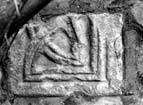
Object type: String-course fragment
Measurements: In its present position, the stone has been turned through 90 degrees; therefore the present width is actually the height of the stone and the height is the surviving width. Correctly orientated: H. 16 cm (6.3 in); W. 11.5 cm (4.5 in).
Stone type: Very pale orange (10YR 8/2) variably grain to matrix supported spar cemented oolite with mainly solid ooliths which range in size from 0.2 to 0.6 mm. Cleeve Cloud Member, Birdlip Limestone Formation, Inferior Oolite Group, Middle Jurassic.
Plate numbers in printed volume: Ill. 213; Fig. 20H
Corpus volume reference: Vol 10 p. 186
(There may be more views or larger images available for this item. Click on the thumbnail image to view.)
First recorded in the course of fieldwork in Deerhurst during 1971–3 (Rahtz 1976, 25).
Part of a terminal stone probably from a string-course. The stone carries a plain, square-section border on three sides, the fourth being broken. The single-strand, median-incised interlace is well carved, but not completely regular. The interlace bends sharply back on itself where it meets the end border of the stone. The background has been cut back within the borders of the stone, leaving the strands of interlace raised.
This fragment, and the very similar fragment (Deerhurst St Mary 22), probably come from a string-course, and their remarkably crisp and relatively unweathered state might indicate that this was an internal string-course. There is no obvious location for such ornament in the surviving Anglo-Saxon structure of the church, but much has been lost including most of the polygonal apse, a major cross wall between the nave and the central space (the present choir), and porticus on the north and south sides of the nave and flanking the apse at the east end.
