Select a site alphabetically from the choices shown in the box below. Alternatively, browse sculptural examples using the Forward/Back buttons.
Chapters for this volume, along with copies of original in-text images, are available here.


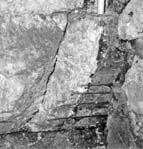
Object type: String-course
Measurements: H. 25.5 cm (10 in); W. (see location above and description below.); D. projects c.16.5 cm (6.5 in) at the top and c.1 cm (0.4 in) at the bottom. It is not known how far the stone goes back into the wall.
Stone type: Yellowish grey (5Y 8/1) mainly grain supported muddy oolite. The ooliths are mainly solid and range in size from 0.2 up to 1.2 mm. Cleeve Cloud Member, Birdlip Limestone Formation, Inferior Oolite Group, Middle Jurassic.
Plate numbers in printed volume: Ills. 211-2
Corpus volume reference: Vol 10 p. 185-6
(There may be more views or larger images available for this item. Click on the thumbnail image to view.)
Carved string-course on the outer faces of the north and south walls of the nave, that appears to start at the junction point with the west walls of the main north and south porticus. The string-course then stretches westwards to the west end of the nave, and around onto the face of the west wall. The western ends are embedded in the north and south walls of the tower/porch. The string-course has a stepped cross-section and, from the floor of the church, the overall effect is of seven steps. However, in detail the moulding is more complex, with square-section mouldings above and below two larger mouldings that have straight sides but shallow, concave faces. These in turn are separated by a narrow, square-section moulding (Taylor and Taylor 1965, i, 199–201, fig. 88; Rahtz et al. 1997, 112–15, 148, figs. 40, 89, no. 18 in Table VIII).
It has been suggested that the 'great' string-course may have performed the function of a continuous corbel course for a roof with eaves at this level. However it is now generally accepted that the walls of the nave of the church were taken up in masonry to at least their present height in Period IV, well above the level of this string-course. The 'great' string-course could, therefore, be a decorative seating for high-level windows, or a visual demarcation between the lower part of the walls (against which the porticus were built) and the upper part of the walls (Taylor 1978, 912; Rahtz et al. 1997, 128 n. 50, 167–9, 172, fig. 104). The string-course might also have served as an external marker of the level of an internal floor (Bagshaw et al. 2006, 98–9).
