Select a site alphabetically from the choices shown in the box below. Alternatively, browse sculptural examples using the Forward/Back buttons.
Chapters for this volume, along with copies of original in-text images, are available here.


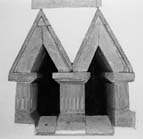
Object type: Double triangular-headed opening
Measurements: H. 201 cm (79 in); W. 205 cm (80.6 in); D. (at impost level) c. 85 cm (33.4 in). (General overall dimensions only; see scale drawing Fig. 41 for detailed measurements of individual components.)
Stone type: The various elements of the window seem to be made of the same stone, a pale yellowish orange to greyish orange (10YR 7/4 to 6/6) grain supported, spar-cemented oolite with oolith grains ranging in size between 0.2 and 0.6 mm. In some parts the stone has a stronger orange staining as if it had been subjected to fire. Cleeve Cloud Member, Birdlip Limestone Formation, Inferior Oolite Group, Middle Jurassic.
Plate numbers in printed volume: Ills. 215-7; Figs. 20B, 41
Corpus volume reference: Vol 10 p. 187-9
(There may be more views or larger images available for this item. Click on the thumbnail image to view.)
Double triangular-headed opening at the level of the second-floor chamber in the tower/porch. The triangular heads are each formed from two large dressed stone slabs, with square-section hood-mouldings on both faces, that pass through the full thickness of the wall. There is a lewis-hole in the southernmost slab, indicating that this is probably a reused Roman stone. The slabs and the hood-mouldings rise from stepped imposts. The north and south imposts have five steps on all faces, with the lowest step on the east face in each case almost flush with the face of the respond and wall. The central impost probably had five steps on all faces (the west face is now very damaged), with those on the east face and the surviving steps on the west face being much wider to compensate for the recessed faces of the pier (see below). Most of the west face of the northern respond impost has been broken away. All the corners of the respond imposts have also been broken off, and all but one (the south-east) on the central impost. Below the imposts, the openings are framed by square-section jambs and a single, square-section central pier, all of which sit on hollow-chamfered bases. The base for the central pier was originally hollow-chamfered on all four faces. The respond bases were only chamfered through the wall thickness, on their north and south faces respectively. Below the chamfer on the southern base there are incised lines that start at the eastern corner and continue westwards for some distance. As with the triangular head-stones, the jambs and central pier are through-stones, although the central pier retains some of the characteristics of a more normal mid-wall shaft in that, while the impost and base pass through the full thickness of the wall, the pier itself is recessed by about 14 cm from the wall face on the eastern and western sides. The central pier is also set at a slightly skewed angle to the wall face and impost.
Both jambs and the central pier are decorated with reeded-fluting (also called cabled-fluting). The fluting covers almost the full height of the pier and the responds, and consists of straight-sided, vertical grooves, round-ended and with shallow concave cross-sections. Each flute is outlined with a fine incised line. The width varies, especially on the west face of the central pier. On the east faces of the responds and central pier, and on the north and south faces of the responds, the upper half of each flute carries a reed, shaped like the flattened head of a bull-rush (Ills. 215–16). On the north and south faces of the central pier the reeds occupy the lower half of each flute, while on the west face of the central pier the reeds are carved alternately at the top and bottom of the fluting (Ill. 217). The central pier carries six flutes on both east and west face, five flutes on its southern face and seven flutes on its northern face. The northern and southern responds carry three flutes on the eastern face, one on the eastern edge of the return face through the wall thickness (the southern and northern faces respectively), and none on the western face. At a date later than the original installation of the double opening, the chamfers on the bases within the northern opening were trimmed back flush with the sides of the jamb and central pier, and the sill of the opening was cut down to form a doorway.
The surface of the stone is smoothed or burnished, and covered with a 'stoney-buff' ground layer that presumably acted as a primer for now lost polychrome. A significant amount of red paint is in fact still visible on the west face of the central pier, especially on the fluting, but whether this is of contemporary date has not yet been established. The ground layer has also not yet been analysed.
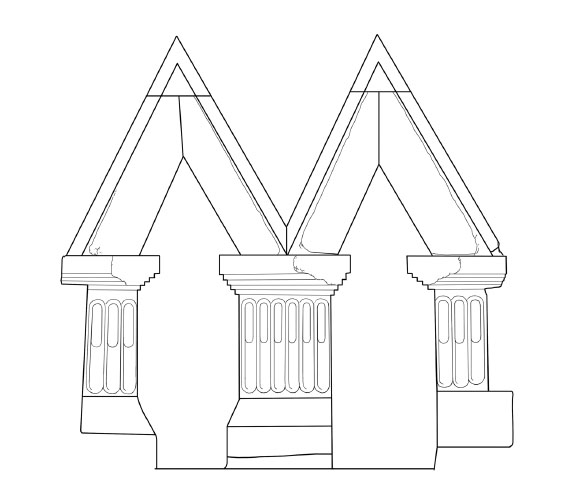
Fig 41
1:20 Elevation of the east face of the double triangular-headed opening (Deerhurst 23)
Archaeological analysis has established that the double opening was inserted into the existing Period IV fabric of the west wall of the nave, and it was therefore assigned to Period V (late ninth century or later) in the development of the church (Rahtz et al. 1997, 115, 141, 179, figs. 85, 89, and no. 29 in Table VII). Hare has shown that, at the level of the opening, the west wall of the nave and the porch/tower are fully in bond (Hare 2009, 55–6), so the double-opening should be seen as an enhancement for an existing chamber. Single and double triangular heads are a reasonably common feature of Anglo-Saxon architecture, used above doorways and window openings and as blind arcading with vertical pilasters. The third volume of Taylor's monumental survey (Taylor 1978, 807–10, 871, 874–5) lists many examples including major churches such as Barnack, Brigstock and Earls Barton (Northamptonshire), Barton-on-Humber (Lincolnshire), Norton (Co. Durham), and Sompting (Sussex). As well as the double opening, St Mary's church at Deerhurst has a triangular-headed doorway (see no. 2, p. 162) leading from the central space into the north (a) porticus, three triangular-headed squint openings at first floor level at the west end of the nave, and triangular-headed blind arcading on the polygonal apse (see no. 4, p. 168). Like the double opening, the doorway is an inserted feature in a Period IV wall, and it is therefore clear that at Deerhurst the use of triangular-heads is common to both Periods IV and V (ninth and tenth centuries: for more details on the dating see discussions for nos. 4 and 13, pp. 169, 179). There are also two triangular-headed panels set high in the east wall of the church (nos. 7 and 8, Ills. 151–2), and on the northern panel a mid to late tenth-century painted figure has been found (p. 173). The figure is nimbed and stands below a triangular-headed 'arch' with stepped imposts very similar to those of the double opening (Bagshaw et al. 2006, 102).
The fluting on the responds and central pier is a decorative motif that derives ultimately from classical columns and pilasters, but is also found in Carolingian architecture. In Aachen, at the chapel attached to Charlemagne's palace, a mid-wall central shaft decorated with fluting survives in a double window in what may be part of the passage that connected the palace to the chapel. One end of this passage was built against the north tower of the westwork of the chapel and formed the east wall of the atrium in front of the chapel. The palace complex is securely dated to the late eighth century (Brown 1903, 301; Oswald et al. 1966–71, 14–17). Both triangular-headed arcading and fluted pilasters can be found on another Carolingian building, the detached gatehouse (Torhalle) in the outer court of Lorsch Abbey, dated to the early to mid ninth century (Jacobsen et al. 1991, 252–3). Fluted pilasters, flanking a fictive doorway and supporting a triangular pediment, can also be found on the front face of the reliquary altar of S. Maria del Priorato in Rome. The inscription on this altar was dated by Nicolette Gray to the mid ninth century (Gray 1948, 118–19, pl. XVIII), but Riccioni has more recently argued that the inscription and the altar should be dated no earlier than the second half of the tenth century (Peroni and Riccioni 2000, 141–50, fig. 24).
